HUMAN OR AI · SELF-CHECK
Human or AI: does my writing sound AI?
Often, yes — and usually not because of the words you chose. Five structural habits carry most of the signal: flat sentence rhythm, announced transitions, forced balance, generic examples and total closure. Vocabulary barely matters. Answer five questions about your own draft and see which habits are doing the work.
Five questions about your draft
Check complete
Does my writing sound AI?
It can, and the cause is almost never a banned word. Readers who say a draft “sounds like AI” are reacting to rhythm and structure: sentences of even length, paragraphs that announce their own purpose, claims that refuse to take a side, examples that could belong to any company, and endings that leave nothing open. Those are habits, not fingerprints. A careful human can produce all five; a careless model can miss several.
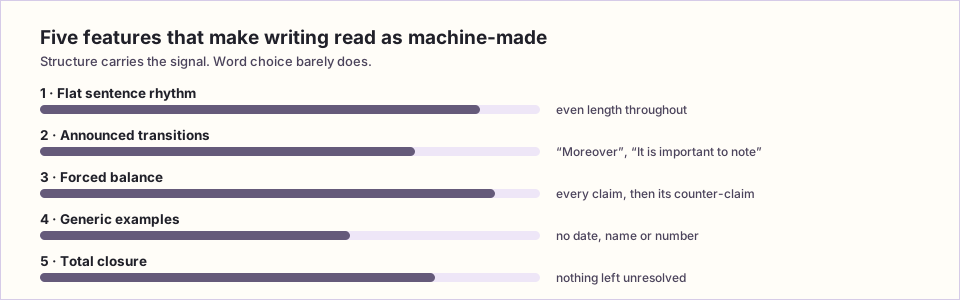
The check above scores how many of those five habits your draft shows. It does not score authorship, and it cannot: nothing in the text carries a reliable mark of who produced it.
Why “sounds like AI” is a weak test
The phrase describes a reader’s discomfort, not a measurable property. Two drafts with identical features can come from different authors. A person writing under deadline, in a second language, or in a regulated format will often produce the same flat rhythm a model produces by default. Meanwhile a model prompted for “short, blunt, specific, unresolved” can clear all five checks.
That is why this site is a guessing game with known labels rather than a detector. Perfect grammar does not settle it, and short texts carry even less to judge.
The five features, one at a time
1. Flat sentence rhythm. Count the words in ten consecutive sentences. Human drafting usually swings — a three-word sentence next to a twenty-eight-word one. Machine drafting clusters near a comfortable middle. The fix is not “write longer”; it is to let one sentence be embarrassingly short.
2. Announced transitions. “Moreover,” “In addition,” “It is important to note that” — these tell the reader what the paragraph will do instead of doing it. Human writers use them too, but usually at lower density. If every paragraph opens with a signpost, the draft reads as assembled rather than thought.
3. Forced balance. A paragraph that gives every claim a counter-claim, then declines to conclude, is the most recognizable habit of all. Real positions have stakes. If your draft could be published by both sides of an argument without edits, it has this feature.
4. Generic examples. “Many companies,” “studies show,” “experts agree” — these are placeholders where a date, a name or a number should be. Specific detail is the cheapest way to sound human, because inventing it is work. That is also why fabricated specificity is a real risk: a model asked for detail will supply it whether or not it is true.
5. Total closure. Every thread tied off, no loose observation, no admitted uncertainty. Human writing usually leaves something unresolved — a doubt, an aside, a question the author could not answer. Complete closure is a design goal, not a natural outcome.
How to read your score
0–1: few machine-shaped habits. If readers still say it sounds generated, the cause is probably outside these five features — check why human writing gets flagged. 2–3: mixed. Usually one habit dominates; fixing it changes how the whole draft reads. 4–5: strongly machine-shaped. Any two of the five are enough to trigger the reaction, so start with rhythm and closure.
These bands describe this exercise. They are not a validated measure of authorship, writing quality or detection accuracy.
What to change first
If you want a draft to read less machine-made, change structure before vocabulary. Break the rhythm with one very short sentence. Delete the transition that announces a paragraph and let the paragraph start with its claim. Take a position and let one counter-argument stay unanswered. Replace one generic example with a dated, named one you can actually verify. Leave one thing unresolved.
None of that makes the text “human.” It makes it less uniform, which is the only thing the five features measure.
What this check cannot tell you
It cannot tell you who wrote a text, whether a student used a tool, or whether a document is trustworthy. It reads five structural habits in a draft you describe, and nothing else. There is no text submission, no model call and no identity result — the questions and scoring run in your browser. Existing site analytics are described in our privacy policy.
Related checks and background
Why human writing sounds like AI → · Does perfect grammar mean AI? → · Do typos mean human? → · Why short texts are hard to judge → · How the homepage questions are made →
We carry forward the fixed comparison-site observation recorded on October 22, 2026: Human or Not opens with a short chat and ends with an identity guess. We use a task-first order, not its wording or live-chat function. This check asks you to describe your own draft, then reports which habits are present.