HUMAN OR AI · CORRECTION CHECK
Can a self-correction prove someone is human?
No. Saying “wait, I meant…” does not establish who wrote a message. Play the correction check: choose what follows from the revised information.
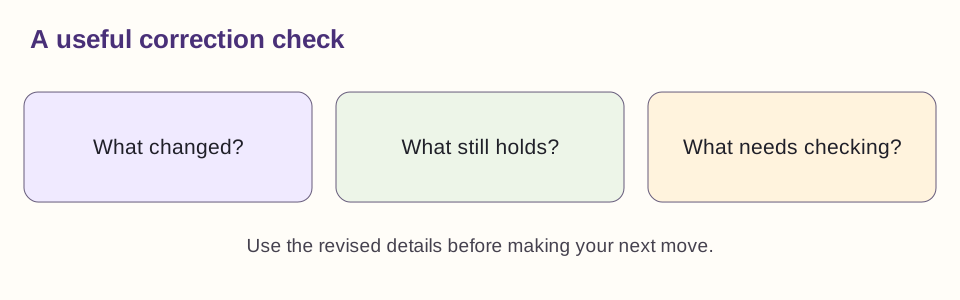
What changes after the correction?
Choose the supported next step.
Round complete
This is a context-tracking score, not AI-detection accuracy.
A correction is something to follow up on
A person can change their mind, mix up two dates, or correct a typo. Generated dialogue can contain those same moves. A single correction leaves authorship unresolved. The useful question is whether the next message reflects the revision.
This page asks a narrower, answerable question: does a choice follow from the information shown? Even a consistent answer does not prove a human wrote it, and an inconsistent answer does not prove AI wrote it.
How to play and interpret the score
Each round randomly draws six different cases from twelve original scenarios. Read the first message and its correction. Choose one answer; it locks and reveals the explanation immediately. Each supported answer earns one point. There is no time bonus.
0–2: Some superseded details carried into your answers. 3–4: You tracked some changes but missed others. 5–6: You consistently used the updated information in this round. These bands describe this exercise only; they are not a validated measure of reasoning or authorship detection.
What should I ask after “sorry, I meant…”?
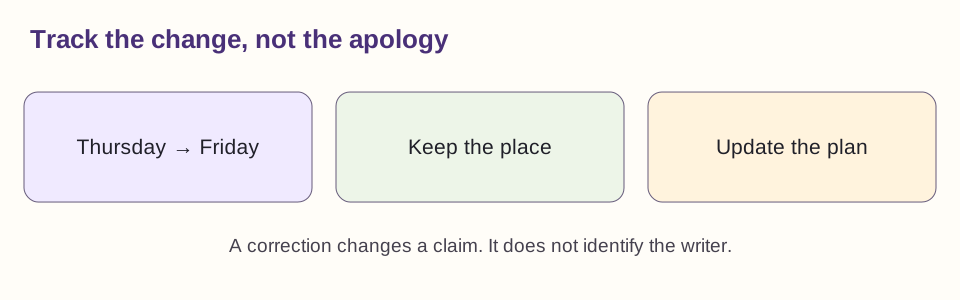
Ask about a consequence of the exact correction. If Thursday becomes Friday, ask whether the time or location stays the same. If a product recommendation changes, ask which earlier reason still applies. Do not switch to a disconnected trick question.
What if the correction removes a fact without replacing it?
Keep that detail unresolved. “That was a different café” withdraws a location; it does not supply a new one. Ask for a checkable detail instead of filling the gap yourself.
Can AI imitate a self-correction?
A fictional generated dialogue can include an apology and a revised claim, as the examples on this page demonstrate. That is enough to make the presence of a correction inconclusive. It says nothing about how frequently people or models correct themselves.
All twelve worked examples
Open a case to review both messages, the answer and the reasoning. You can play without reading the answers first.
A meeting moves
First: Meet me at the library on Thursday, after lunch.
Correction: Sorry, Friday, not Thursday. Same place and time.
Check: Which plan now follows the correction?
Answer: Library on Friday, after lunch. The day changed. The library and after-lunch timing were explicitly kept.
The borrowed charger
First: I borrowed the blue charger from Mia.
Correction: Wait, the green one. Mia lent it to me this morning.
Check: What was corrected?
Answer: The charger color; Mia is still the lender. Green replaces blue. The second message still identifies Mia as the lender.
A recipe for friends
First: This recipe serves four. Double it for eight.
Correction: I read the wrong line: it serves two. We still need enough for eight.
Check: How should the base recipe be scaled now?
Answer: Make four times the base recipe. Eight portions divided by two portions per recipe gives four batches. The target did not change.
A train connection
First: The train leaves at 6:40. I want to be there twenty minutes early.
Correction: Correction: departure is 6:20. I still want the same buffer.
Check: What arrival time follows from both messages?
Answer: 6:00. The corrected departure is 6:20. Keeping the twenty-minute buffer means arriving at 6:00.
A rainy-day bag
First: Take the canvas bag; it is waterproof.
Correction: I mixed up the labels. The nylon bag is waterproof, not the canvas one.
Check: Which detail should guide the rainy-day choice?
Answer: Choose the nylon bag for the stated waterproof feature. The correction changes which bag has the relevant feature. Admitting a mistake does not establish identity.
A book recommendation
First: I loved the ending, but the opening dragged.
Correction: Other way round: the opening hooked me; the ending felt rushed.
Check: Which follow-up uses the corrected opinion?
Answer: What made the ending feel rushed? Ask about the revised opinion. The original praise for the ending was withdrawn, and no claim about all stories was made.
A delivery address
First: Leave it at number 18, upstairs.
Correction: Number 81, sorry. Still upstairs, not at the street entrance.
Check: Which delivery instruction is supported now?
Answer: Number 81, upstairs. The number changes to 81. Upstairs remains in force and the street entrance is explicitly excluded.
A limited correction
First: The gallery closes at five and entry is free.
Correction: Closing is six, I checked. I have not checked the entry price.
Check: What is supported by the latest message?
Answer: Closing at six; the price remains unverified. The closing time was checked and corrected. The second message does not verify the price.
A different comparison
First: The small fan is quieter, but moves less air.
Correction: I swapped them: the large fan is quieter. It also moves more air.
Check: Which comparison follows the revision?
Answer: The large fan is quieter and moves more air. Both claims about the large fan are explicit in the revision. Equal airflow was never stated.
A renamed file
First: Use draft-final.pdf; it has the updated chart.
Correction: Wrong filename: review-copy.pdf has the update. Please ignore draft-final.pdf.
Check: Which file should be used?
Answer: review-copy.pdf. The revision names the replacement file and explicitly withdraws the earlier instruction.
A correction without a replacement
First: The café is next to the station.
Correction: No, that was a different café. I cannot remember where this one is.
Check: What is the useful next move?
Answer: Ask for a map link or another checkable location detail. The earlier location was withdrawn without a replacement. Asking for evidence is better than inventing one.
A shared bill
First: We split the bill between three people, so each owes twelve.
Correction: I forgot Sam. Four of us split the same total equally.
Check: What does each person owe after the correction?
Answer: Nine. The original total is three times twelve, or thirty-six. Dividing the unchanged total by four gives nine.
Design, provenance and limitations
Designed October 16, 2026. All twelve scenarios, choices and explanations are original fictional examples written with AI for Guess Human AI. They are not presented as human quotations. The cases cover revisions to a date, object, quantity, time, attribute, opinion, address, verification status, comparison, filename, missing location and shared cost. Distractors retain an old detail, introduce an unsupported detail, or jump to an identity label.
This page is not an AI detector. It does not analyze uploaded text, pair you with another player, or certify authorship. The exercise runs in your browser. The page uses the site's existing analytics; see the privacy policy.
Sources and related play
- Human or Not — reviewed October 16, 2026 for its short conversation followed by an identity guess. Our exercise uses written cases rather than live chat.
- Jannai et al., Human or Not? (2023) — background on conversational Turing-style games. The study does not validate this correction exercise.