HUMAN OR AI · STORY CHECK
Human or AI: does a consistent story prove someone is human?
No. Agreement between messages shows continuity, not who wrote them. Play the Story Check: decide what the information supports before making an identity guess.
What does this story actually establish?
Round complete
Three different judgments
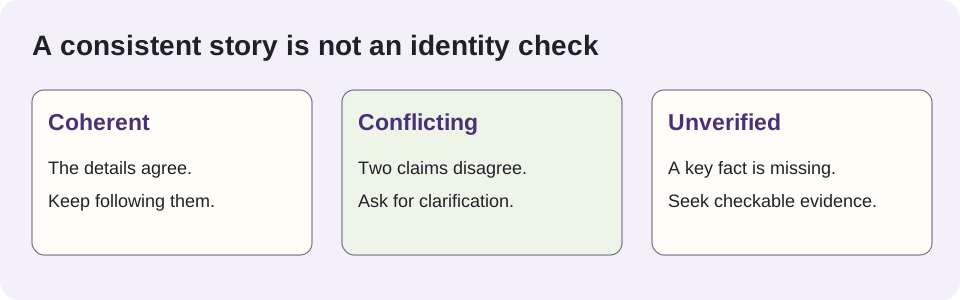
A story can agree with itself without matching the outside world. A repeated place or name is continuity. Two incompatible claims about the same unchanged event create a conflict. A missing measurement, date or independent record leaves a claim unresolved. None of these categories identifies an author.
How to play and read your score
Each round draws six different cases from twelve original fictional scenarios. Read the messages and the exact question, then choose one category. Each supported choice earns one point. Feedback appears immediately; there is no timer or speed bonus.
0–2: Revisit the difference between agreement and verification. 3–4: Some distinctions held; check for missing evidence and explicit revisions. 5–6: You consistently classified the evidence shown in this round. These are practice bands, not a validated measure of reasoning or AI detection.
Does changing a story always make it inconsistent?
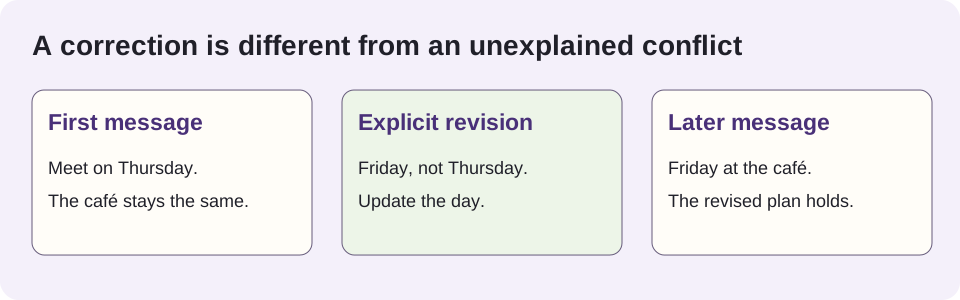
No. An explicit correction replaces an earlier detail. A conditional plan can also change when its stated condition changes. Ask which detail changed and why. Do not treat every revision as deception, and do not treat an apology as proof of a person.
What should I ask next?
Follow the detail already introduced. For a repeated ticket number, ask for a checkable ticket detail. For two different quantities in an unchanged box, ask which statement is being corrected. For a bag size, ask for measurements and the relevant limit. A disconnected trick question does not resolve the missing fact.
All twelve worked cases
Open these after playing to compare the supported answer and its reasoning.
The blue chair
The blue chair is by the window.
I left my bag on that blue chair by the window.
Question: What does this establish about the room?
Answer: The detail holds together. The two claims agree. No independent evidence establishes whether this room exists or who described it.
A revised appointment
I will meet you on Thursday.
Correction: Friday. Same café.
See you at the café on Friday.
Question: Is the last message inconsistent with the corrected plan?
Answer: The detail holds together. Friday explicitly replaced Thursday. A stated correction should update the plan rather than count as an unexplained contradiction.
The charger changes color
Mia lent me her green charger.
It was the same charger, with no cover or color change.
Mia’s charger was blue when she lent it to me.
Question: How should the two color claims be treated?
Answer: The account contains a conflict. The same charger at the same lending event is called both green and blue, with no explained change. This is a conflict to clarify, not proof of AI.
An unmeasured bag
My bag fits under the seat.
The airline has a size limit.
I have not measured this bag.
Question: Can we verify that it meets the airline’s size limit?
Answer: More evidence is needed. Fitting somewhere and meeting a particular measured limit are different claims. The dimensions and the limit are missing.
A change in the weather
If it rains, we will use the indoor court.
It stopped raining, so we chose the outdoor court.
Question: Is the plan change itself an unexplained contradiction?
Answer: The detail holds together. The plan was conditional. The second message supplies a changed condition that explains the new choice.
The uncertain key
I might have left the key in my coat.
I have not checked.
I am certain it is in my coat because I already checked.
Question: Do the claims about checking agree?
Answer: The account contains a conflict. The account switches from not checking to already checking without giving a new event. Ask when the check happened before drawing further conclusions.
The repeated ticket
My ticket says seat 14.
Yes, I am in seat 14.
That is the number I remember too.
Question: Do these messages prove the ticket really says 14?
Answer: More evidence is needed. Repeating a number is consistent but does not independently verify the ticket. A checkable ticket detail would be stronger evidence.
A fixed box
This unopened box contains exactly two mugs.
Nothing was added or removed.
This same unopened box contains exactly three mugs.
Question: Can both quantity claims hold under the stated conditions?
Answer: The account contains a conflict. Exactly two and exactly three cannot both describe the unchanged contents. The conflict is about the story, not the writer’s identity.
The borrowed book
I borrowed the book from Arun on Monday.
Arun asked for his book back.
I will return it to Arun.
Question: Does the lender remain consistent?
Answer: The detail holds together. All messages use Arun as the lender. That agreement is useful continuity, but it does not establish human authorship.
A missing date
The shop closed before I arrived.
I went there yesterday.
I do not remember which branch I visited.
Question: Can we verify the branch’s closing time from this account?
Answer: More evidence is needed. The relevant branch and a checkable schedule are missing. Do not invent a closing time to complete the story.
The switched route
We stayed inside the whole trip.
There was no outdoor part and no later correction.
Halfway through that trip, we walked outside across the square.
Question: How should the route claims be classified?
Answer: The account contains a conflict. An outdoor segment conflicts with staying inside for the whole unchanged trip. A clarification may resolve the account, but identity remains unknown.
A reason that still holds
I chose the quiet room because I needed to record audio.
I still need to record, so I kept the quiet room.
Question: Is the reason connected across the two messages?
Answer: The detail holds together. The need to record and the quiet-room choice remain connected. A coherent reason is not an identity certificate.
Design and provenance
Designed October 17, 2026. All twelve cases, choices and explanations are original fictional examples written with AI for Guess Human AI. They are not quotations from people, research trials or model benchmarks. The structure covers consistent details, explicit revisions, changed conditions, incompatible claims and missing external evidence. The score measures choices in this exercise only.
This page is not an AI detector. It does not analyze uploaded text, verify identity or connect you to a chat partner. The game runs in your browser; the page retains the site's existing analytics. See the privacy policy.
Background and related play
- Human or Not — reviewed October 17, 2026 for its short conversation followed by a guess. Our practice cases are not live conversations.
- Human or Not? research background — contextual reading about conversational Turing games, not validation of this exercise.