The short answer
Humans write clean copy for contracts, support replies, documentation, school assignments, and public posts. They also use spellcheck, grammar tools, templates, editors, and patient revision. AI can make mistakes, imitate slang, or follow a prompt that asks for fragments. Grammar quality and authorship are different questions.
“No errors” is an observation. “AI wrote it” is a conclusion. One does not prove the other.
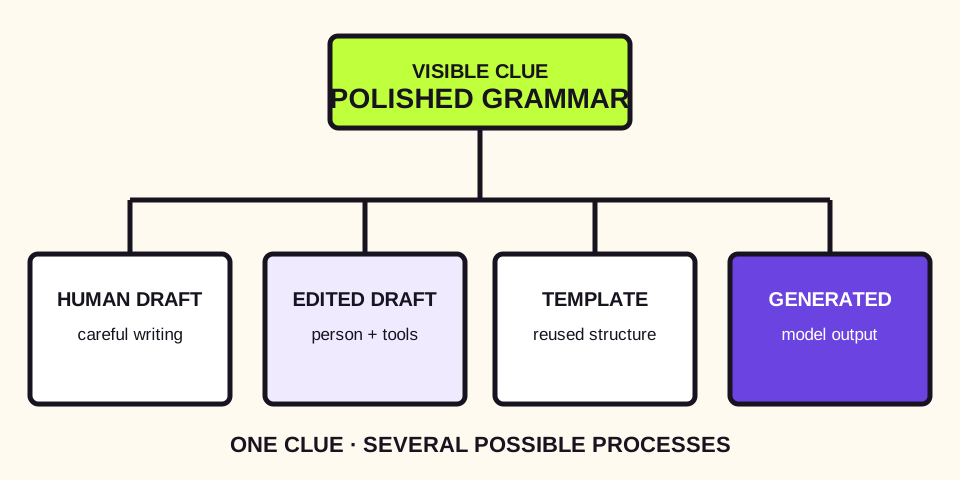
Five grammar traps
- Every sentence is complete. Professional and academic formats often reward complete sentences.
- The punctuation is consistent. A style guide, template, or copy edit can create the same pattern.
- There are no spelling mistakes. Spellcheck removes surface errors without identifying who formed the ideas.
- The tone stays neutral. Support, policy, and technical writing often suppress personality on purpose.
- The transitions are tidy. Writers learn reusable transitions; models also reproduce them. The clue is shared.
TRY THE CLUE
Play the 2020 Mix
The new pool pairs 12 sourced human forum comments from 2020 with 12 synthetic passages matched for topic, length, and informal voice. Each round draws four from each side and reveals the known label after every guess.
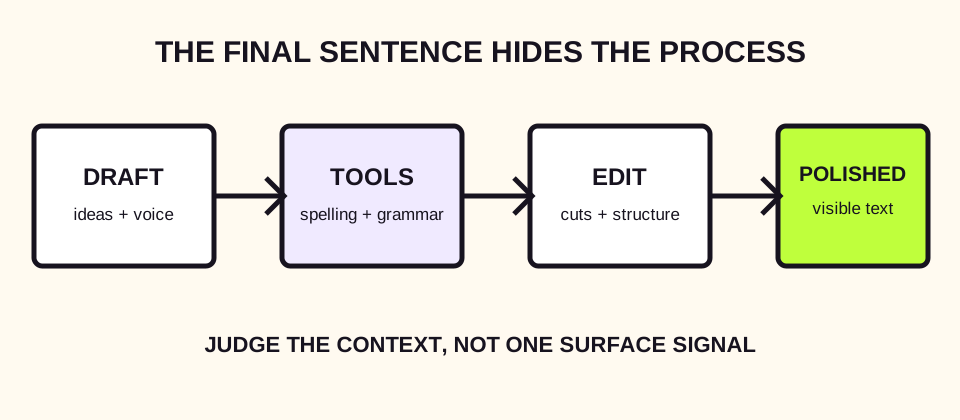
What to check instead
- Task: Was the writer answering a narrow prompt that encourages predictable wording?
- Process: Was the passage edited, translated, templated, or polished?
- Specificity: Does it make concrete choices that fit the situation?
- Comparison: Are you comparing texts from the same era, topic, length, and setting?
- Stakes: Is a playful guess being mistaken for an accusation?
What the evidence changes
OpenAI withdrew its own text classifier in 2023 and listed limits involving short, predictable, edited, and out-of-distribution text. A 2023 study reported detector bias against non-native English writers. A 2025 ACL paper found that AI polishing makes detector decisions unstable.
Inference: because editing, predictable tasks, and writer background can all change surface style, grammatical polish alone is too weak to carry an authorship verdict.
- OpenAI: New AI classifier for indicating AI-written text (updated July 20, 2023)
- Liang et al.: GPT detectors are biased against non-native English writers (2023)
- Saha and Feizi: The Challenge of Detecting AI-Polished Writing (ACL Findings, 2025)
This page is not a detector
It does not inspect your text or decide who wrote it. It explains why one popular clue—perfect grammar—cannot prove authorship.