HUMAN OR AI · HUMOR CHECK
Human or AI: can a joke prove someone is human?
No. A joke can show a possible contrast, reference or timing choice. It does not prove who wrote the text. Play six short cases and choose what the context supports.
What does the context actually support?
Round complete
Can a joke prove someone is human?
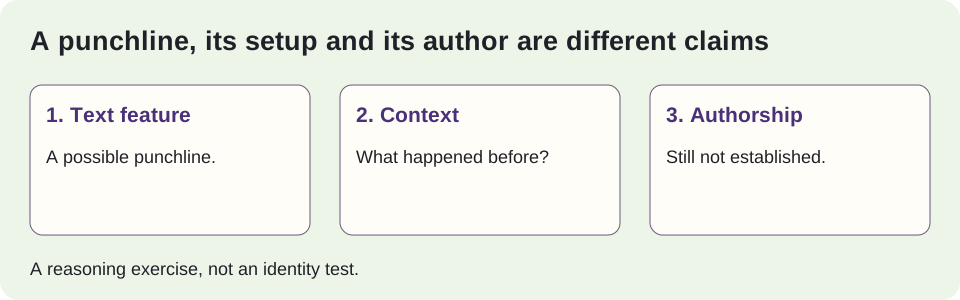
No. A line can rely on irony, a double meaning, an exaggeration or a shared reference. Those are features of a text in context. They are not reliable evidence of the author’s identity. This exercise asks what an account says and what evidence is actually present.
How to ask about a joke without asking for private information
Find the supplied setup. Ask what “it” refers to, whether a phrase has two meanings, or why a stated detail changed.
Allow a plain answer. A short line may be literal. Do not force irony or invent a hidden punchline.
Respect the boundary. A person can decline personal stories, and a culture reference can be unfamiliar. Use an invented scene or ask for a short explanation instead of requesting addresses, documents or private photos.
Does being funny prove someone is human?
No. A funny or well-timed line may be written, edited, quoted or generated. A response that does not land can also depend on audience, language and timing. Neither outcome identifies an author.
What does a callback show?
A callback can show that a phrase was retained or copied from earlier text. It is not an independent source for the event in the joke. Count evidence by its source, not by how many times the same line appears.
How to play and read your score
Each round randomly selects six different cases from sixteen original fictional scenarios. A supported choice earns one point; other choices earn none. Answers lock after selection and feedback explains the context. There is no timer or speed bonus.
0–2: Review the setup before deciding what a line means. 3–4: Some distinctions held; watch for missing context and borrowed jokes. 5–6: You consistently used the context in this round. These practice bands are editorial choices, not a validated measure of humor or authorship detection.
Review all sixteen cases
Every case below is AI-assisted fiction written for this exercise. None is presented as a genuine participant’s joke or personal history.
The literal umbrella
“Nice weather,” Mira said as rain soaked the picnic blanket.
Question: What does the line most directly invite you to consider?
Supported choice: The contrast between the words and the rain. The line supplies a contrast that may make “nice weather” ironic. Reading that contrast does not identify the writer.
The missing setup
Everyone laughed after Theo said, “That is one way to solve it.”
Question: What is missing before you can explain the joke?
Supported choice: What “it” refers to and what happened before. The context needed to interpret “one way to solve it” is absent. Ask for the setup instead of inventing it or turning uncertainty into an identity verdict.
The quoted punchline
I copied my aunt’s line: “I finally found my keys—inside the freezer.”
Question: What does the message establish?
Supported choice: The writer repeated an attributed joke or anecdote. The source is explicitly attributed to the aunt. Repeating a line is not a separate firsthand event and does not settle authorship.
The quiet room
Jordan told a pun about a calendar. Nobody laughed.
Question: What is the supported conclusion?
Supported choice: Nobody laughed in this account; that alone says nothing about the writer’s identity. A reaction can vary by audience, timing and taste. Absence of laughter is not an authorship test.
The double meaning
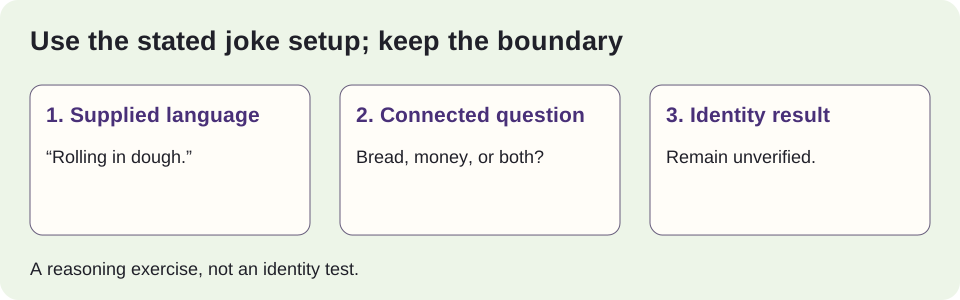
The baker said the business was “rolling in dough.”
Question: Which question uses the supplied language?
Supported choice: Is “dough” being used for bread, money, or both?. The phrase may use two senses of “dough.” Asking about the wording is connected and does not require personal data.
The culture reference
Rae smiled at a reference to a show I have never watched.
Question: What is a fair response?
Supported choice: Ask for a short explanation of the reference. A reference can depend on shared culture or prior knowledge. Ask for an explanation or keep the interpretation uncertain.
The correction
“I meant the printer, not the toaster,” Sam added. “The toaster joke would have been better.”
Question: Which detail should a follow-up keep?
Supported choice: The explicit correction and the stated alternative joke. The correction updates the account while preserving why the earlier version was humorous. A revision is not a verdict about who wrote it.
The exaggerated plan
After one late bus, I said I would move to the moon to avoid public transport.
Question: What kind of claim is most likely shown?
Supported choice: An exaggeration that depends on a frustrating delay. The exaggerated scale contrasts with the ordinary inconvenience. It may be hyperbole, but it does not reveal the author’s identity.
The shared reference
I said “same old spreadsheet,” and Priya replied with the same phrase.
Question: How many independent sources for the underlying spreadsheet problem appear?
Supported choice: One shared reference; repetition is not independent confirmation. The exchange repeats one phrase about the same issue. It may show shared context, not two independent confirmations or identity evidence.
The unexplained emoji
Kai replied “😂” after a list of printer errors.
Question: What should remain open?
Supported choice: Why the emoji was used and what the speaker found funny. The reaction has insufficient context. It is safer to ask what was funny than to treat an emoji as a human-or-AI signal.
The fictional scene
In my story, the robot groans at a dad joke.
Question: What does the framing tell you?
Supported choice: The scene is presented as fiction. “In my story” labels the scene as fictional. Do not promote a narrative device into a report about the real world or its author.
The follow-up constraint
The joke depends on a cat named Byte and a broken keyboard.
Question: Which follow-up stays connected to the joke?
Supported choice: What did Byte do after the keyboard stopped working?. It builds from the stated setup. A connected question can explore the account without requesting private details or promising an identity result.
The uncertain translation
The translator says the wordplay may not carry into English.
Question: What is a proportionate conclusion?
Supported choice: The original joke needs linguistic context; its effect may remain uncertain. Wordplay can depend on language-specific sounds or meanings. Preserve the uncertainty rather than forcing an identity judgment.
The prepared callback
Later, I reused the earlier “freezer keys” line.
Question: What has reuse shown?
Supported choice: The speaker remembered or copied an earlier line, not an independent event. A callback can show continuity in the text. It neither verifies the original event nor tells you who authored the words.
The straight answer
“Why did the document fail?” “Because the link was broken.”
Question: What is the safest reading?
Supported choice: It could be a literal answer; no joke need be assumed. Not every compact line is a joke. Use the supplied context and allow a plain reading when no humorous cue is stated.
The author question
The joke is specific, well-timed and uses a familiar reference.
No source or author information is supplied.
Question: What should the final judgment say?
Supported choice: The text has those features; authorship remains unverified. Humor, timing and polish are text features. This exercise asks what the supplied evidence supports, not who must have produced it.
How this set was built
Design date: October 20, 2026. Sixteen original cases cover irony, missing setup, quoted punchlines, puns, cultural references, corrections, exaggeration, callbacks and translation uncertainty. Each has three choices, an editorially supported answer and an explanation. The scenario count and score bands describe this game’s design; they are not research findings.
This page is not an AI detector. There is no live partner, text submission or model call. Choices and scoring run in your browser. Existing site analytics are described in our privacy policy.
Related games and background
We reviewed the fixed comparison site Human or Not on October 20, 2026. It begins with a short chat and ends with an identity guess. We borrow the direct task-first order, not its wording or live-chat function. Humor Check instead uses prepared cases that ask what the shown context supports.
Practice connected follow-ups → · Separate stories from evidence → · Check the homepage question sources →