HUMAN OR AI · EXPERIENCE CHECK
Human or AI: do personal stories reveal who wrote them?
No single personal story proves human authorship. Read the account and choose what the evidence supports. No private details needed.
What does this story actually show?
Round complete
Can asking about personal experiences reveal AI?
A personal-experience question can give you an account to examine. It does not create a reliable identity test. In these fictional examples, first-person language, sensory details and emotion are parts of the story. A separate question is whether any event or source has actually been checked. A checked event is still not automatically a checked author.
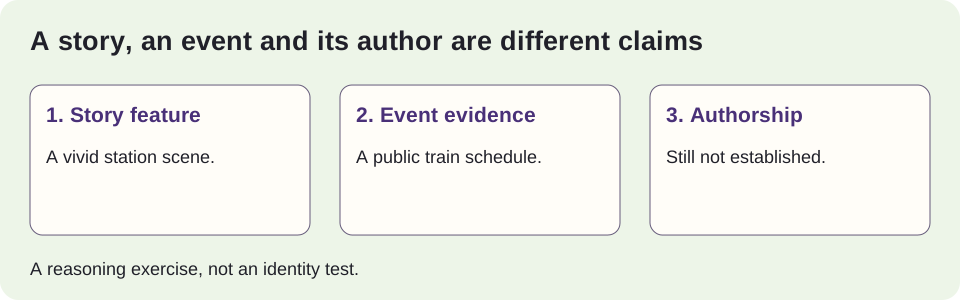
A follow-up that uses the story, not a private life
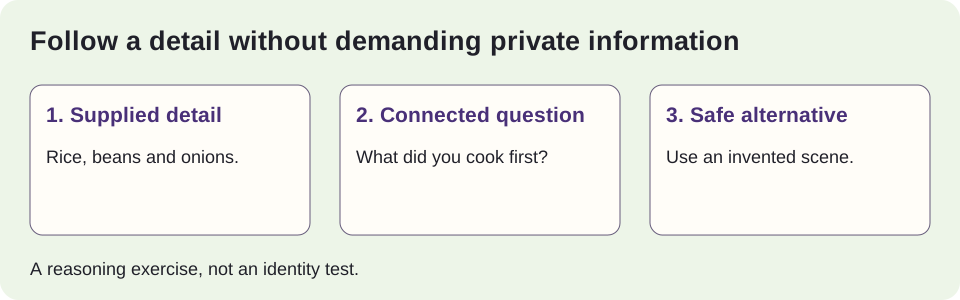
Use one supplied detail. If the account mentions rice, beans and onions, ask about the cooking sequence. Do not introduce a hidden correct answer.
Keep the scope narrow. Ask what happened next or why a stated decision changed. Allow the answer to be uncertain or fictional.
Stop at the boundary. Do not request a home address, identity document, private calendar or private photograph for an authorship game. Offer an invented scenario when someone declines a personal question.
Do sensory details prove a lived experience?
No. “Wet concrete and coffee” describes a smell in an account; it does not demonstrate that its writer was at a station. The useful distinction is between a claim appearing in text and evidence supporting that claim. Treat detail as something to reason about, rather than a shortcut to a human-or-AI verdict.
Does an emotional answer prove someone is human?
No. “I felt relieved” reports an emotion within the account. On its own it cannot verify the interview, the feeling or the writer’s identity. This exercise does not award points for demanding increasingly intimate disclosures.
What if the speaker cannot remember?
Keep the missing detail unknown. Ask a connected clarification if useful, or move on. Do not make up a song, date or object color and then punish an answer for failing to match it. A refusal to share is also a boundary, not an identity result.
How to play and read your score
Each round randomly selects six different cases from sixteen original fictional scenarios. Each supported choice earns one point. Other choices earn none. Feedback explains the evidence, and answers lock after selection. There is no timer or speed bonus.
0–2: Review the difference between story features and supported claims. 3–4: Some distinctions held; watch first-person wording and privacy boundaries. 5–6: You consistently used the evidence provided in this round. These bands are editorial practice feedback, not a validated score of authorship-detection ability.
Review all sixteen cases
Every case below is AI-assisted fiction written for this exercise. None is presented as a genuine participant’s personal history.
The smell of the station
I was waiting for the train. The platform smelled like wet concrete and coffee.
Question: What does this sensory detail establish?
Supported choice: The account contains a sensory description; its origin is still unverified. A sensory description is a feature of the account. The passage gives no independent way to verify the event or identify the writer.
A borrowed first-person story
I missed the last ferry and slept on a bench.
To be clear, that is a line from a story I am drafting.
Question: Which claim survives the clarification?
Supported choice: The passage is presented as fiction, not a report of a trip. The clarification changes the claim from personal testimony to fictional narration. First-person wording can be a storytelling choice.
No remembered song
We listened to music while packing.
I do not remember what song was playing.
Question: What is a connected follow-up?
Supported choice: Ask which part of packing the music interrupted, if they remember. Follow the context already offered and allow uncertainty. A missing song title is not an identity test.
A private address
The walk home after dinner took longer than I expected.
Question: Which follow-up respects the privacy boundary?
Supported choice: Ask what made the walk take longer, without requesting an address. The reason for the delay relates to the story. Home addresses and identity documents are unnecessary for this practice conversation.
A traceable quotation
My brother described his first day in a kitchen.
I am retelling his account, not describing my own job.
Question: How should the source be labeled?
Supported choice: A second-hand account attributed to the brother. The passage explicitly gives a second-hand source. Preserving that attribution avoids treating a retelling as an eyewitness claim.
A public event listing
I went to the outdoor film on Saturday.
The public event listing confirms a screening happened on Saturday.
Question: What does the listing alone verify?
Supported choice: That a screening was listed, not who attended. An event record and a person’s presence are separate claims. The listing does not link this writer to attendance.
The changed detail
I said the café table was by the door.
Sorry, I meant the window. We sat there to see the rain.
Question: What should the next question use?
Supported choice: The revised window location, while keeping the correction in context. An explicit correction updates the stated scene. You can follow the revised detail without using the revision as an identity verdict.
A feeling without a fact check
I felt relieved when the interview ended.
Question: Which conclusion is supported by the passage?
Supported choice: The narrator describes relief; the experience is not independently verified. An emotional statement tells you what the account says. It is not external evidence of the interview or of who produced the words.
A neutral alternative
I would rather not discuss my childhood.
Question: How can the game continue?
Supported choice: Offer an invented, non-personal scenario instead. Participation need not depend on disclosing private experiences. A fictional scenario can support a reasoning exercise without making an identity claim.
An invented extra detail
I spilled tea on a notebook.
The page does not say which hand held the cup.
Question: Can you score an answer against a supposed left-hand detail?
Supported choice: No: the hand was never supplied in the account. A fair follow-up uses supplied information or asks for clarification. It should not invent a hidden answer and judge the writer against it.
A photo with a narrow claim
Here is a public photo of the park fountain.
The story claims I visited it yesterday.
Question: What remains unresolved by a photo of the fountain alone?
Supported choice: Who took it and whether this writer visited yesterday. A picture may show a fountain, but that does not by itself establish the photographer, date or author of the account. Do not request private images for this game.
The useful constraint
I made dinner using only rice, beans and onions.
Question: Which question stays connected to the account?
Supported choice: Which of those ingredients did you cook first, and why?. A sequence question uses a stated constraint. It may reveal how the account is developed, but it still cannot certify human authorship.
Repeated travel story
I told you about losing my scarf at the museum.
Yes, I lost my scarf at the museum.
Question: Has a new independent source been introduced?
Supported choice: No: the second statement repeats the same account. Repetition can show continuity, but it does not create independent evidence for the event.
A hypothetical outing
If I had a free afternoon, I would take a long bike ride.
Question: What kind of statement is this?
Supported choice: A hypothetical preference, not a report that a ride happened. The conditional wording describes an imagined possibility. Do not silently turn it into evidence of a completed event.
Uncertain timing
I think it was the weekend before the concert.
I would need to check the date.
Question: What is a proportionate response?
Supported choice: Keep the timing uncertain or move to a non-sensitive detail. Respect the stated uncertainty. This game does not require private calendar access, and an uncertain date does not settle identity.
Story versus author
The scene is specific, consistent and written in the first person.
No source for the event has been checked.
Question: What should the final judgment say?
Supported choice: The account has those features; the author’s identity remains unverified. Story features and authorship are different questions. This exercise rewards the conclusion supported by the supplied evidence, not a confident identity guess.
How this set was built
Design date: October 19, 2026. Sixteen original cases cover sensory language, fictional narration, missing memories, privacy boundaries, attributed retellings, public records, corrections and hypothetical statements. Each has three choices, an editorially supported answer and an explanation. The scenario count and score bands describe this game’s design; they are not research findings.
This page is not an AI detector. There is no live partner, text submission or model call. Choices and scoring run in your browser. Existing site analytics are described in our privacy policy.
Related games and background
We reviewed the fixed comparison site Human or Not on October 19, 2026: it begins with a short live chat and ends with an identity guess. We borrow the direct task-first sequence, not its wording or live-chat function. Experience Check instead asks what a prepared account supports.
Practice connected follow-ups → · Separate recall from evidence → · Check the homepage question sources →