HUMAN OR AI · DETECTORS
Human or AI: do AI detectors actually work?
Partly — they measure how predictable a text is, not who wrote it. Two measurements do most of the work: how expected each next word is, and how much sentence length varies. Both can be computed from any passage, and neither is a record of authorship. That is why a detector can flag a human draft with confidence and wave through machine text that has been lightly rewritten.
Below are three passages. Every one of them was written by a person. Each one still gives a detector something to fire on. Pick the heuristic that would catch it, then read why.
Three passages, three heuristics
Exercise complete
Next: why human writing gets flagged → · guess the writer with known labels →
Do AI detectors actually work?
They work as measurements of text and fail as measurements of authorship. That distinction sounds like hair-splitting until you need the answer for something real — a grade, a hiring decision, a byline, a client who thinks you outsourced the work. At that point the difference between "this text scores as machine-shaped" and "a machine wrote this" is the entire question, and the tool only answers the first one.
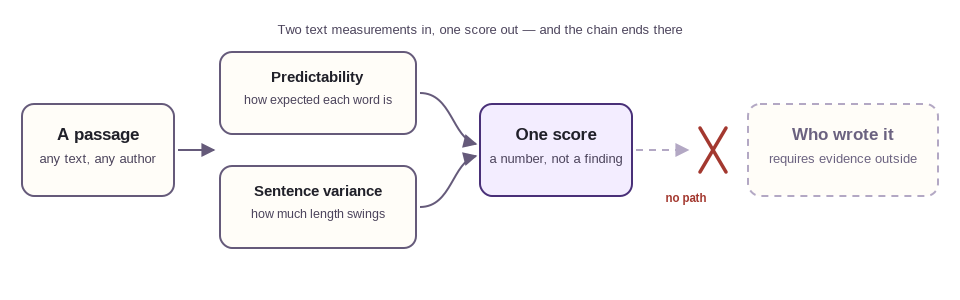
Everything a detector reports sits to the left of that cut. The score is real, reproducible, and about the text. The author is on the other side, and no amount of re-scoring gets you across.
What a detector actually measures
Most tools combine two properties. The first is predictability: a language model assigns a likelihood to each next word, and a passage built out of common phrases is easy to predict. The second is variance: how much sentence length and structure swing from one sentence to the next. Machine drafting tends to cluster near a comfortable middle; human drafting tends to swing.
Neither property is a fingerprint. Both describe the text in front of you, and both can be produced deliberately by a person. A writer working in a second language produces more predictable phrasing. A writer following a house style produces more uniform sentences. A writer on a deadline produces a flatter rhythm than the same writer on a good day.
Why human writing gets flagged
The false flags are not random. They cluster in four situations:
- Writing in a second language. Learner vocabulary is narrower and syntax more regular, which reads to the model as low predictability.
- Regulated or templated formats. Lab reports, legal notices, cover letters and press releases are uniform because the genre demands it. Uniformity is exactly what the tool measures.
- Heavy editing. Several passes smooth out the swings. The final draft is more even than the first draft, and more even than the writer actually is.
- Short texts. A few sentences give the model almost nothing to measure, so the score rests on very little. Short text is hard to judge for the same reason.
Notice what these have in common: none of them involve a machine writing anything. All four are situations where a person's text happens to look the way machine text looks by default.
Why machine text gets through
The reverse failures are just as systematic, and they are the reason a clean score proves nothing:
- A paraphrasing pass. Rewriting raises predictability variance without changing who wrote it. The output is still machine-made and now scores lower.
- Asking for variation. "Vary sentence length, take a position, be blunt, leave something unresolved" attacks the two measured properties directly.
- Layered human edits. A few rewritten paragraphs shift the average of the whole document.
- Choosing a uniform genre. A résumé bullet or a product spec is uniform by design, so uniformity stops being evidence.
Put together, the two failure lists mean the score is close to uncorrelated with the thing people want to know. It tracks how the text is built. It does not track who built it.
What a score is not
A score is not a finding. It is not proof of misconduct, not a measure of writing quality, and not stable across tools, versions, genres or text lengths. We deliberately do not quote an accuracy figure on this page. Published numbers move with the tool, the version, the corpus and the length of the sample, and a figure measured on one corpus does not transfer to your document. Anyone who offers a single accuracy number for "AI detection" as a general property is describing one test, not the technology.
There is a second reason to be careful with the number: detection tools are commercial products that get retrained. A score from last year's version of a tool is not reproducible today, and a result you cannot reproduce is not evidence of anything.
If a detector flagged your writing
Treat the score as a claim that needs support, and ask for the support:
- Which tool, which version, on what date.
- What threshold was used, and what the tool's own documentation says that threshold means.
- What in the text triggered it — most tools can show the flagged spans.
- Whether the same text, run twice, returns the same score.
Then supply process evidence: earlier drafts, notes, outlines, version history, the messages where you discussed the piece. A score describes a document. Drafts describe a writer, and they are the thing actually in dispute. Do not run your text through a paraphraser to beat the number — that changes the document, not the question, and it destroys the draft history that would have helped you.
If you are the one assessing
Text-only verdicts are weak evidence, and they are weakest exactly where the stakes are highest. If you need to know whether a person wrote something, the useful evidence is procedural: drafts, notes, in-session writing, a short conversation about choices the writer made and could defend. If you use a tool at all, use it as one signal among several, record the version, and never present a score as the finding.
Why this page is not a detector
The exercise above shows you three passages whose origin we know and asks you to reason about which heuristic fires. It does not score text you paste, does not call a model, and does not tell you who wrote anything — the passages and the scoring run in your browser. That is the same boundary the rest of this site holds: the game shows you text with known labels, you guess, then you find out. A guess with a known answer is a fair test of judgment. A score with an unknown answer is not.
If you want the underlying habits rather than the tooling, start with whether your own writing sounds AI and why human writing sounds machine-made. If the text is very short, read why short texts are hard to judge first.
Related checks and background
Play the Human or AI game → · Does my writing sound AI? → · Why is my writing flagged as AI? → · Why human writing sounds like AI → · Why short texts are hard to judge → · Does perfect grammar mean AI? → · Do typos mean human? → · How the homepage questions are made →
We carry forward the fixed comparison-site observation recorded on October 22, 2026: Human or Not opens with a short chat and ends with an identity guess. We use a task-first order, not its wording or live-chat function. This page asks you to reason about a detector's heuristics, then reports which property of the text each one measures.