HUMAN OR AI · FLAGGED CHECK
Why is my writing flagged as AI?
Because the detector is not measuring who wrote your text. It measures how predictable your text is. Two numbers do most of the work: perplexity, which asks how surprising each next word is, and burstiness, which asks how much sentence length and rhythm vary. Formal writing, edited writing and careful second-language writing all push those numbers toward the machine side. That is a property of the prose, not a fact about the author.
Which rewrite would score as more machine-like?
Case 1 of 5Loading
Round complete
What the two numbers actually measure
A language model assigns a probability to every next word. Perplexity is a summary of those probabilities across a passage: low perplexity means each word was easy to guess, high perplexity means the passage kept surprising the model. A detector compares your text against a reference model and reports the average. Burstiness looks at variation instead of average: human drafts usually mix long sentences with short ones, while heavily edited or templated text tends to even out.
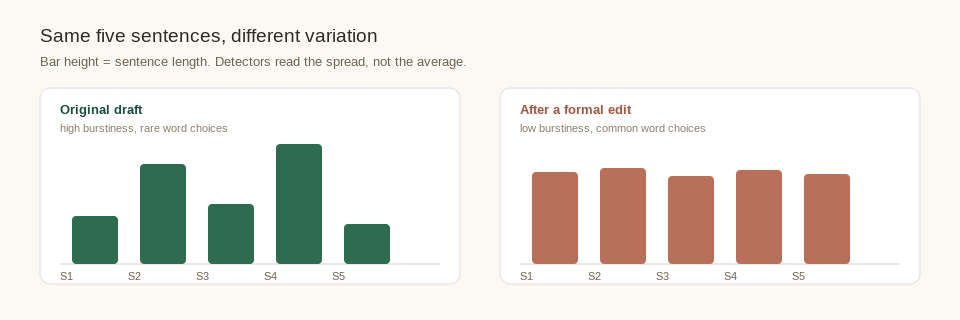
Neither number contains information about identity. They describe the text. A person who writes in complete, evenly paced sentences with common vocabulary produces the same numbers as a model trained to do exactly that. The detector cannot tell the two apart because the input it receives is identical.
Why formal writing scores as machine-like
Formal prose is deliberately predictable. Style guides ask for consistent terminology, parallel structure, neutral tone and no rhetorical surprise. Every one of those instructions lowers perplexity. A policy memo that avoids idiom, repeats its defined terms exactly and keeps sentences the same length is doing what formal writing is supposed to do, and it is also doing what a detector reads as machine-like.
Academic writing adds another layer. Citation conventions, hedged claims and standard section order all reduce variation. A methods section written by a careful researcher can score lower than a casual paragraph written by a chatbot, because the researcher was trained to remove exactly the variation the detector rewards.
Why edited and second-language writing get flagged
Editing flattens prose on purpose. Cutting redundancy, unifying tense and smoothing transitions raises readability and lowers burstiness at the same time. A text that passed through a copy editor, a translation step or a style checker has been made more predictable by a human decision, and the detector sees only the result.
Second-language writing is a documented problem. Writers working in a non-native language tend to choose the most reliable word rather than the most interesting one, and to reuse sentence patterns that they know are correct. That is a reasonable strategy and it lowers perplexity. Published research has found that several widely used detectors flag non-native English writing at substantially higher rates than native writing on the same assignments. The pattern is a property of how the tools score, not evidence about the writers.
What the score does not tell you
A detector returns a probability produced by a particular model on a particular day. It does not return evidence, a chain of reasoning, or a statement about authorship. Two detectors given the same paragraph routinely disagree, and the same detector can move a text across the threshold after a light rewrite that changes no facts.
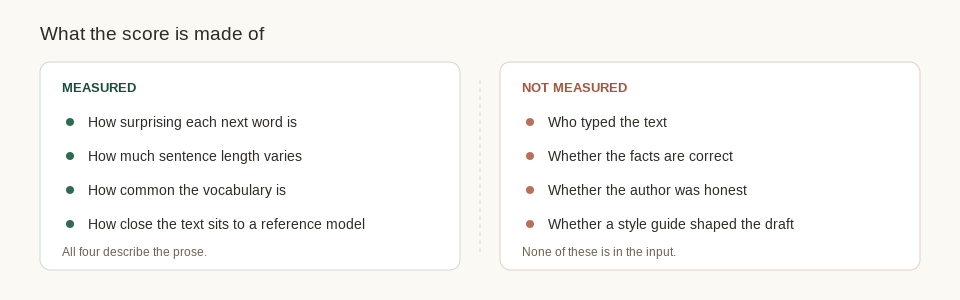
This is why a flagged result is a question, not a verdict. The useful follow-up is to ask which passage triggered the score, what the reference model was, and whether the same text scores differently when the formal constraints are relaxed. If a paragraph is flagged only because it follows a house style, the flag is describing the style guide.
If a detector flagged your own work
Keep your drafts. Version history, timestamps and notes are stronger evidence than any counter-score. Ask the person relying on the result what threshold was used and what the tool claims to measure. If the answer is a percentage with no method behind it, the number is not carrying the weight being placed on it. Our guide to what detectors can and cannot do covers the failure modes in more detail.
How this set was built
Designed October 31, 2026. Each case shows one human-written source sentence and three rewrites. The supported answer is the rewrite that removes the most variation: it replaces a specific word with a more common one, evens out sentence length, or adds a stock transition. The exercise is about recognising the direction of the score, not about producing text that evades a detector.
This page is not an AI detector. It does not accept text, call a model, or score anyone. The cases and the scoring run only in your browser. Existing site analytics are described in our privacy policy.
Related reading and practice
Check your own writing for the usual tells → · Why human writing sounds like AI → · Does perfect grammar mean AI? → · Does AI overuse certain words? →