HUMAN OR AI · CURRENT FACTS CHECK
Human or AI: does a current fact prove someone is human?
No. A current-looking fact can be accurate, stale or conditional. It does not prove who wrote the text. Play six short cases and choose what the time context supports.
What does the time context actually support?
Round complete
Does a current fact prove someone is human?
No. A date, a status update or a precise live-looking number can help check a claim. It does not show who wrote the words. Current Facts Check separates a claim’s time context, source and author.
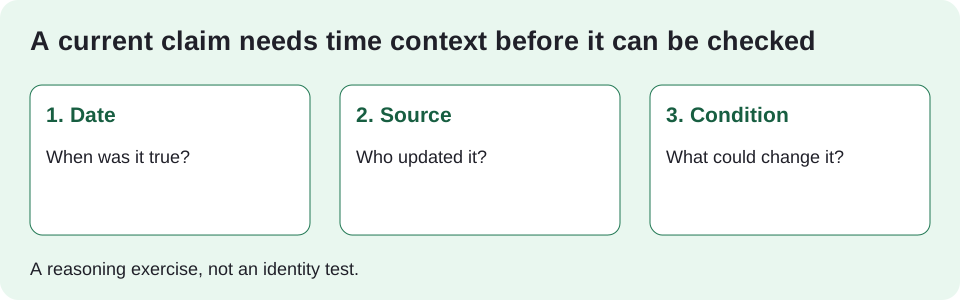
How to check a current claim
Anchor the time. Keep the publication date, timezone and any relative word such as “today” or “tomorrow.”
Match the source. Prefer a dated source that covers the condition and time actually being asked about.
Keep the boundary. A current source can support a present claim. It does not ask for private information or prove whether a human or AI wrote the text.
Can a live-looking detail prove who wrote it?
No. A status may be current, stale, copied or conditional. Check when it was updated and what it covers. Treat the author’s identity as a separate unanswered question.
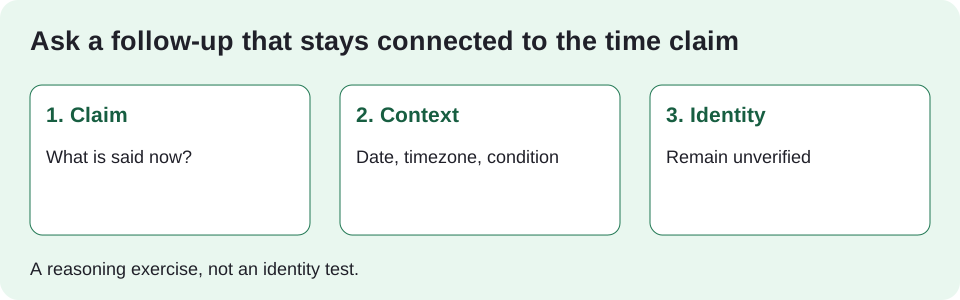
How to play and read your score
Each round randomly selects six different cases from sixteen original fictional scenarios. A supported choice earns one point; other choices earn none. Answers lock after selection and feedback explains which time context is present. There is no timer or speed bonus.
0–2: Start by anchoring the claim to a date, source and condition. 3–4: Some distinctions held; watch for stale displays and relative dates. 5–6: You consistently kept time, source and authorship separate. These practice bands are editorial choices, not a validated measure of fact-checking or authorship detection.
Review all sixteen cases
Every case below is AI-assisted fiction written for this exercise. None is presented as a live status, observed participant statement or verified current fact.
Yesterday’s weather card
“It was sunny at the pier yesterday,” says a saved weather card.
The question asks whether it is sunny there now.
Question: What does the card support?
Supported choice: Yesterday’s dated observation, not today’s weather. A dated card can support a past claim. Current weather needs a current source; neither claim identifies the writer.
The old opening-hours post
A venue posted “Open every Monday” last year.
A newer notice says “Closed this Monday for repairs.”
Question: Which source fits a visit today?
Supported choice: The newer, dated notice for the stated day. Time and conditions can change. Use the newest source that covers the actual date, without treating the change as an authorship clue.
The future event listing
A calendar says a talk begins at 7 p.m. on Friday.
No year or timezone is shown.
Question: What should be clarified?
Supported choice: The year, timezone and whether the listing is current. A time only becomes useful when its date and timezone are known. Clarifying the claim is more useful than guessing authorship.
The stale screenshot
A screenshot says “Seats available.”
It was captured two weeks ago.
Question: What remains unknown?
Supported choice: Whether seats are available now. A screenshot preserves a past display. It does not automatically describe the current state or who wrote the message.
The revised price
“The membership is $24,” a message says.
The linked page shows an update dated after the message.
Question: What is the careful response?
Supported choice: Use the dated update and name the date. Prices can change. A dated update may revise the claim; it does not identify the author.
The copied headline
Three posts repeat “The road is closed today.”
All link to one unsigned repost.
Question: How many independent current sources are visible?
Supported choice: One claim until an original dated notice is found. Repeats may all come from one source. Count underlying, current sources instead of copies.
The conditional alert
“The trail closes after heavy rain,” says the notice.
No rain status is included.
Question: What should the next question ask?
Supported choice: Whether the stated condition applies now. A conditional rule needs its condition checked. That is a fact question, not a test of authorship.
The live counter
A page says “12 people are waiting.”
The page also says “updated five minutes ago.”
Question: What does the number mean?
Supported choice: A time-stamped report, not a timeless fact. A live-looking number still has a timestamp and update method. Preserve those limits before relying on it.
The updated correction
“The shop opens at nine—update: ten today,” the post says.
Question: Which detail should a follow-up retain?
Supported choice: The explicit update and its date. An explicit update changes the operating claim. It can be checked, but correction alone is not an identity signal.
The archive snapshot
A cached page lists a software version as current.
The software publisher’s release notes name a newer version.
Question: Which source is stronger for today?
Supported choice: The publisher’s newer release notes. For a current version, a newer primary release record is more relevant. The source choice does not determine who wrote the text.
The relative date
“The pop-up starts tomorrow,” the post says.
The post has no visible publication date.
Question: What is missing?
Supported choice: A reference date for “tomorrow”. Relative dates need an anchor. Without a publication date, the time claim cannot be placed reliably.
The source with a clock
An observatory page says “Visible tonight.”
It shows a timezone and a last-updated time.
Question: What is the best next move?
Supported choice: Check whether its timezone and update time fit your question. A source with time context can support a current claim when its scope matches the question. It still does not reveal authorship.
The unavailable live page
A message links to a status page, but it no longer loads.
Question: What should the answer say?
Supported choice: The current status is unverified until another current source is found. When a live source cannot be checked, preserve that uncertainty. Do not fill the gap with an identity verdict.
The recurring notice
A notice says “First Tuesday each month.”
This month has a special holiday exception.
Question: What should be checked?
Supported choice: The exception for this month. Recurring rules can have dated exceptions. Check the current period before treating a general pattern as today’s answer.
The personal observation
“I walked past and the cafe was open,” says a post.
The post is from last winter.
Question: What does first person wording establish?
Supported choice: A past reported observation, not today’s status. First-person language can report an event, but a dated past observation is not a current operations source and does not prove identity.
The final current-fact question
The message includes a date, a precise number and a source.
No author information is supplied.
Question: What conclusion is supported?
Supported choice: The claim may be checked in context; authorship remains unverified. Date, detail and a source help evaluate a claim. They are not a reliable way to identify who composed it.
How this set was built
Design date: October 22, 2026. Sixteen original cases cover dated observations, temporary status, conditional notices, corrections, revised prices, relative dates, timezones and stale screenshots. Each has three choices, an editorially supported answer and an explanation. The scenario count and score bands describe this game’s design; they are not research findings.
This page is not an AI detector. There is no text submission, live data lookup, model call or identity result. Choices and scoring run in your browser. Existing site analytics are described in our privacy policy.
Related games and background
We carry forward the fixed comparison-site observation recorded on October 22, 2026: Human or Not begins with a short chat and ends with an identity guess. We use a task-first order, not its wording or live-chat function. Current Facts Check uses prepared cases to ask what a time-sensitive claim supports.
Separate facts from authorship → · Separate stories from evidence → · Check the homepage question sources →