HUMAN OR AI · KNOWLEDGE CHECK
Human or AI: does knowing obscure facts prove someone is human?
No. Knowing an obscure fact can make a claim easier to check. It does not prove who wrote the text. Play six short cases and choose what the evidence supports.
What does the evidence actually support?
Round complete
Does knowing obscure facts prove someone is human?
No. A precise detail, specialist term or citation can make a claim easier to check. It does not reveal who composed the words. This exercise separates what a text says, what a source supports and what remains unknown about authorship.
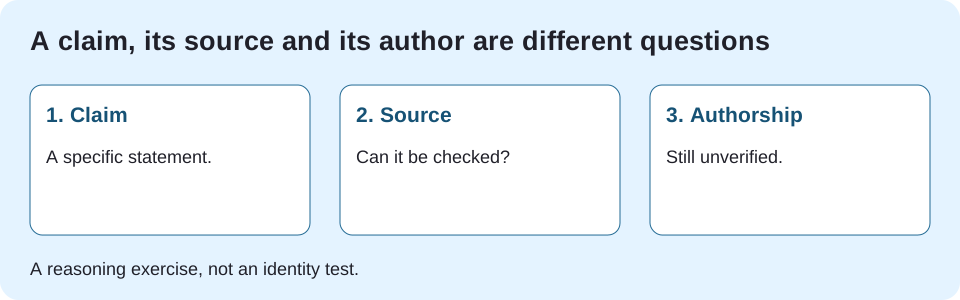
How to check a fact without turning it into an identity test
Name the claim. Keep the date, place, measurement or quotation visible.
Find the source. Ask for a record, edition or dated notice that can be opened and checked.
Keep the boundary. A source can support a factual claim. It does not require private details and it does not prove whether a human or an AI wrote the text.
Do precise facts prove someone is human?
No. A number may be accurate, outdated, copied, guessed or generated. Check units, conditions, dates and independent sources. Treat the author’s identity as a separate unanswered question.
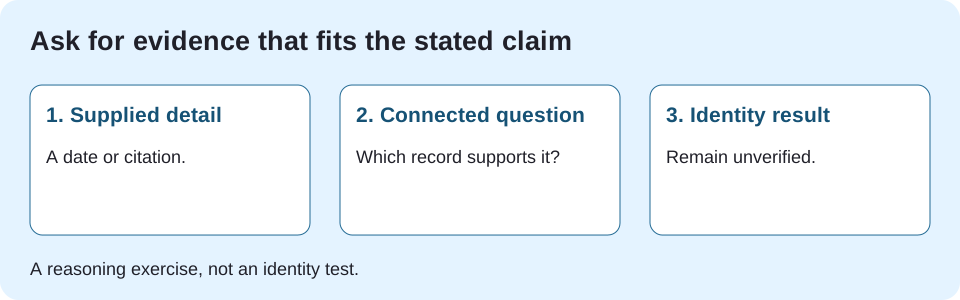
How to play and read your score
Each round randomly selects six different cases from sixteen original fictional scenarios. A supported choice earns one point; other choices earn none. Answers lock after selection and feedback explains what evidence is present. There is no timer or speed bonus.
0–2: Start with the claim and ask what source would check it. 3–4: Some distinctions held; watch for copied statements, old notices and missing provenance. 5–6: You consistently separated claims, sources and authorship in this round. These practice bands are editorial choices, not a validated measure of fact-checking or authorship detection.
Review all sixteen cases
Every case below is AI-assisted fiction written for this exercise. None is presented as an observed participant statement or a verified fact.
The unsourced plant fact
“The moonflower opens after sunset and closes by morning.”
No link, book or observation is supplied.
Question: What is the most proportionate next step?
Supported choice: Ask for a checkable source or mark the claim unverified. The statement may be accurate, incomplete or copied. A source can help assess the claim; neither presence nor absence of one identifies the writer.
The copied trivia line
“Octopuses have three hearts,” the message says.
The next sentence says it was copied from a museum sign.
Question: What does the message establish?
Supported choice: The writer repeated an attributed fact. The attribution describes where this line came from. Repeating a fact is not a firsthand observation and does not settle authorship.
The date correction
“The archive opened in 1891—sorry, 1892.”
Question: Which detail should a careful follow-up use?
Supported choice: The explicitly corrected date, while checking the source. An explicit correction updates the claim. It can still need a source, but a correction is not evidence about the author’s identity.
The precise number
“The lake is 143 metres deep.”
No units source or measurement method is supplied.
Question: What is missing?
Supported choice: The measurement source, location and conditions. A precise number still needs provenance. Ask where and how it was measured before treating it as reliable.
The familiar quotation
“Knowledge is power,” the post says.
No speaker or edition is named.
Question: What remains open?
Supported choice: Which wording and attribution are intended. A familiar quotation may be paraphrased, copied or misattributed. Clarifying the source is more useful than guessing the author.
The obscure word
“In this glossary, ‘brumation’ describes winter dormancy in reptiles.”
Question: What does an unusual term show?
Supported choice: The text uses a specific term; its source and use can be checked. Specialized vocabulary is a text feature. It can be learned from a glossary, source or prompt and does not identify the writer.
The repeated source
A forum post, a repost and a comment all repeat the same museum fact.
Question: How many independent sources are visible?
Supported choice: One underlying claim unless separate sources are shown. Repetition can trace back to one source. Count independent sources, not repetitions of the same statement.
The fictional reference
“In my novel, the city library keeps books that rewrite themselves.”
Question: What does the framing tell you?
Supported choice: The scene is presented as fiction. The phrase “in my novel” labels the scene as fictional. Do not turn a narrative device into a real-world claim.
The remembered answer
“I remember reading that the bridge was painted blue in 1974.”
Question: What is the safest reading?
Supported choice: It is a remembered claim that still needs a source. A memory may guide a search, but it is not an external record. Keep the claim and the author’s identity separate.
The missing edition
“The first edition had a different ending.”
Question: Which follow-up stays connected?
Supported choice: Which title, edition and source are you referring to?. The follow-up asks for the supplied claim’s identifying context without asking for private information or promising an identity result.
The translated phrase
“The proverb sounds shorter in the original language.”
Question: What is a proportionate conclusion?
Supported choice: Translation and wording context may be needed. Meaning can depend on wording, language and source. Preserve that uncertainty instead of turning it into an authorship verdict.
The authority label
“A scientist says this comet is visible tonight.”
No scientist, observatory or date is given.
Question: What should be checked?
Supported choice: The named source, date and observing conditions. An authority label without a source cannot carry the whole claim. Verify the relevant source and current date.
The changed condition
“The trail is open,” an older guide says.
A newer notice says it is closed after rain.
Question: What should a response do?
Supported choice: Use the newer, dated notice and retain the condition. Time-sensitive facts can change. A dated update is relevant evidence; contradiction alone does not identify an author.
The observation claim
“I saw the exhibit close early last Tuesday.”
Question: What does first-person wording prove?
Supported choice: It reports an observation but does not verify the event or author. First-person wording is a claim about an event. It can be followed up with public hours or context, but it does not prove identity.
The useful citation
“The city archive catalogue lists the map as 1910; here is its record number.”
Question: What is the strongest next move?
Supported choice: Open the cited catalogue record and compare the claim. A checkable record helps assess the factual claim. Verifying it still does not identify who composed the message.
The final identity question
The answer is detailed, specific and includes a source.
No author information is supplied.
Question: What should the final judgment say?
Supported choice: The claim can be checked; authorship remains unverified. Detail, precision and sourcing concern a claim’s evidence. They are not a reliable identity detector.
How this set was built
Design date: October 21, 2026. Sixteen original cases cover attribution, citations, precise measurements, corrections, dated updates, translation and independent sources. Each has three choices, an editorially supported answer and an explanation. The scenario count and score bands describe this game’s design; they are not research findings.
This page is not an AI detector. There is no text submission, live partner or model call. Choices and scoring run in your browser. Existing site analytics are described in our privacy policy.
Related games and background
We carry forward the fixed comparison-site observation recorded on October 21, 2026: Human or Not begins with a short chat and ends with an identity guess. We use a task-first order, not its wording or live-chat function. Knowledge Check uses prepared cases to ask what evidence supports.
Separate humor from authorship → · Separate stories from evidence → · Check the homepage question sources →