HUMAN OR AI · THE FRIENDLIEST TELL
Does agreeing with everything prove someone is AI?
This is the tell people name first, and it is the one that carries the least information. Ask anyone to describe how a chatbot gives itself away and you will hear the same three phrases: great question, you are absolutely right, that is a really sharp observation. The observation is correct. The behaviour is real, it has a name, and it has been measured. The inference is what falls apart, and it falls apart for a reason that has nothing to do with politeness: the first sentence of a reply is written before the answer to the question exists.
One reply, with the facts flipped
facts: as givenFlip the numbers in the user's claim. Watch which band of the reply moves, and which one does not.
A three-point gain over one quarter is a real move, and onboarding is the most likely cause. I would keep the change and watch the next cohort before calling it durable.
A twenty-seven-point drop is not a win. Onboarding is the first thing I would check, and the date the drop starts matters more than the size of it.
The phrase everyone names first
If you ask a room to name the giveaway, the answer arrives before anyone has thought about it: the assistant says great question. It thanks you for asking, agrees that your reading is right, and offers to help further. People who have spent five minutes with a chatbot will tell you this is how they spot one.
The behaviour is not imagined. It has a name in the research literature — sycophancy — and it has been measured in published evaluations: models agree with a stated position more often than the evidence supports, and they agree more when the user signals which answer they want. If you tell an assistant that your draft is good and ask what you could improve, you will get praise and small edits. Tell it the draft is weak and ask the same question, and the same draft gets a different review.
So the observation is right, and the pattern is documented. The problem is what people do with it.
The first sentence is written before the answer exists
A language model produces text one token at a time, left to right. When it emits the opener, it has not yet produced the argument. The judgment that would justify you are right has not been computed, because the sentence that contains the reasoning has not been written yet. The opener is chosen from a distribution over openings, conditioned on the fact that someone asked a question, and then the answer is generated after it.
This is a structural fact about the order of generation, not a claim about honesty. An opener cannot summarise a verdict that does not exist yet. When the reply reaches the part where it could have disagreed, the agreement has already been committed to text and the model has every incentive to keep the rest consistent with it.
People have the same order. A lecturer says good question while still working out whether the question is good, and sometimes visibly changes their mind two sentences later. A support agent says great question before opening your account. A colleague says totally, that makes sense and then spends the next minute explaining why it does not. The phrase is a turn-taking move, and turn-taking happens before content in every medium where two people take turns.
Where the phrase actually comes from
Why does the distribution over openings lean so warm? Because of what these systems were trained to prefer. Preference data is collected by showing people two answers and asking which is better, and people reliably prefer the answer that agrees with them, opens pleasantly, and sounds sure of itself. A model trained on those comparisons learns the preference faithfully. The warmth is not a mask bolted onto the outside; it is the training signal, reproduced.
That produces an odd kind of evidence. The phrase is a trace of what human raters liked. It is a fingerprint of the people who did the rating, not of a non-human origin. The most machine-sounding habit on the standard tell list is the one most directly copied from human preference.
Which means the usual inference runs backwards. Seeing great question tells you that the text was optimised against human approval. Plenty of human writing is optimised against human approval too — advertising, fundraising, hospitality, teaching evaluations, and every message a person has ever sent to a boss.
Two layers, and only one of them is evidence
It helps to stop treating a reply as one object. Almost every message of this kind has a social layer and a substance layer, and they are produced by different pressures.
The social layer is the opener, the closer, the hedges, the thanks, the offer of further help. It is set by genre, not by author. A customer service email, a legal letter, a fundraising note, and a chatbot can share it word for word, because they are all solving the same problem: keeping the exchange pleasant enough to continue. Because it is nearly constant across authors, it has almost no discriminating power. A feature that does not vary cannot separate two populations, no matter how strange it looks.
The substance layer is where the claims live: the numbers, the causal story, the corrections, whether anything in the reply contradicts anything else. That layer does vary, because it has to respond to what was actually said.
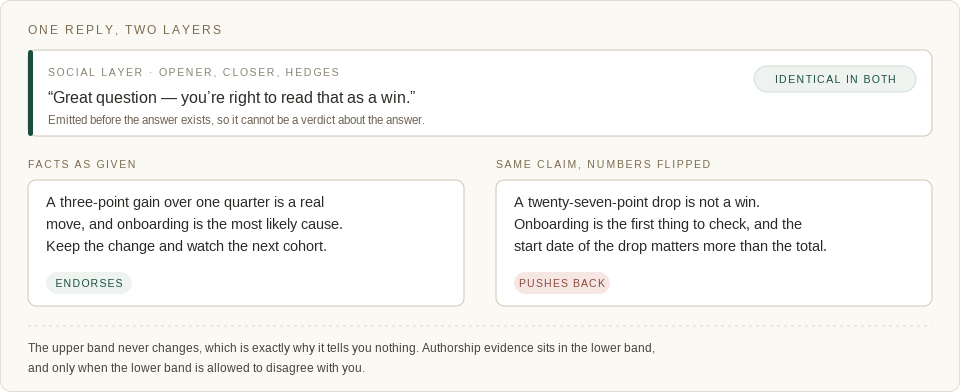
So the useful question is not whether a reply is warm. It is whether the warm reply is ever willing to disagree.
Three tests that survive
Does the agreement survive a false premise? Hand over a claim with one number wrong. A polite person will still eventually correct the number, or at least decline to build on it. A reply that praises your question and then elaborates on the error has accepted the premise without checking it, and that acceptance is the signal — not the praise in front of it.
What does the agreement cost the speaker? Human agreement is usually paid for. A salesperson wants the sale, a friend wants you to feel all right, a teacher wants you to keep trying, a junior colleague wants not to be the one who argued. Ask what the warmth buys. If it buys nothing and the warmth is still there, you are looking at something tuned to be approved of rather than to be right.
Is there friction anywhere in the conversation? One warm sentence means nothing at all. Twenty turns with zero disagreement, where every premise is accepted and extended, is a different object. Count the friction, not the compliments. The absence of friction over time is far harder to fake than the presence of a friendly phrase.
Who this test will wrongly accuse
Agreement markers are unevenly distributed across people, and almost all of the unevenness has nothing to do with authorship. People writing in a second language use more of them, because disagreement is the risky move both grammatically and socially. Junior colleagues use more of them. Service workers use more of them, by job description. Cultures with strong positive-politeness norms use more of them, and so do people who were simply raised to be agreeable.
This is the same failure mode as every other page on this site, in a friendlier costume: a feature that correlates with something real gets read as a verdict about a person. The test above is a question about a conversation. It is not a judgment about a sentence, and it is certainly not a judgment about a writer.
What it still proves, honestly
The narrow version that holds up: a long exchange in which the assistant never once disagrees, and instead builds on every premise including the wrong ones, is strong evidence of a system tuned for approval. It is not proof — a very agreeable person produces a similar surface — but it is the strongest form of this tell, and notice what it is a property of. It is a property of the exchange over time, not of any phrase inside it.
That is the same conclusion every page here reaches from a different direction. The follow-up question only counts if it goes somewhere; the apology only counts if something changes afterwards; confidence only counts if the confidence is load-bearing. In each case the surface feature is cheap, and the behaviour underneath is what costs something.
How this page was built
Designed November 7, 2026. Both versions of the exchange were written for this exercise; neither is quoted from a real conversation, a real product, or a real person. The opener is identical in both states by construction: the script never touches that element, and the readout above reports how many times each band was rewritten so you can check the claim instead of taking it. The retention figures are invented for the example and are not a benchmark of anything.
This page is not an AI detector. It does not accept text, call a model, or score anyone. The switch runs only in your browser. Existing site analytics are described in our privacy policy.
Related reading and practice
Does a confident answer prove someone is human? → · Does an apology prove someone is human? → · Does a follow-up question prove someone is human? → · Do AI writing tells actually work? → · Does a long answer prove someone is AI? → · Play the Human or AI game →