HUMAN OR AI · THE LENGTH TELL
Does a long answer prove someone is AI?
Length is the tell people use most and admit to least. Nobody says "the reply was four hundred words, so it was a machine", but that is very often what happened. The reasoning feels sound: a person answering a simple question says the useful thing and stops, while a system keeps going because stopping was never one of its instructions. The observation is real. What it measures is not authorship — it is who paid for the words.
Cut the padding, keep the claims
originalFive of the nine sentences below carry no information. Remove them one at a time and watch which of the two numbers moves.
The question: is it safe to reheat rice?
Nothing removed yet. The highlighted sentences are the ones carrying no claim.
Every padding sentence is gone and every claim survived. The word count fell by more than half and the answer is not one fact poorer. That is the whole test: if a sentence can be deleted without losing anything, its length was never carrying information in the first place — and that is true whether a person or a program wrote it.
The tell nobody admits to using
Ask people how they spot a machine and they name phrases: great question, the em dash, the bulleted list. Ask them to pick the machine out of two answers and many will quietly use a different criterion. The long one. The one that restates the question, covers three angles, and closes by offering to go deeper.
It is not a foolish instinct. Default length really is a known property of these systems, and it is one of the few properties users complain about by name: people search for why an assistant has become so wordy, and the phrasing they use includes the word now. That single word is worth noticing. A trait that changes with a product update is a setting, not a nature.
Why the default is long
Two pressures push in the same direction. The first is training. Preference data is collected by asking people which of two answers is better, and when one answer is longer and more complete, raters tend to prefer it. Length is not the only thing being rewarded, but it is reliably correlated with being chosen, so it gets learned alongside everything else.
The second is how "helpful" gets operationalised. A system told to be helpful and given no length target will cover the topic, mention the caveats, and offer the next step, because leaving something out is the visible failure and saying too much is not. Verbosity is the safe direction to fail in when nobody has told you where the edge is.
Length is cheap for whoever does not pay for it
Here is the part that gets skipped. For a person, words cost time. Four hundred words is twenty minutes of thinking, typing, and deciding what to leave out. For a system, four hundred words cost about what forty cost, because the work is in generating each token and there are simply more of them.
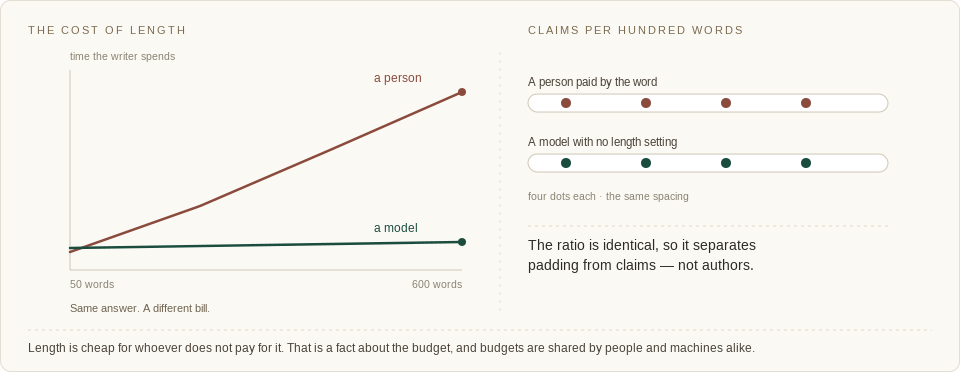
So verbosity is evidence that length was free for that writer at that moment. That is a claim about a budget, and budgets are not distributed by species. People whose length is free write long too: anyone paid by the word, anyone filling a word count, anyone billing by the hour, anyone whose search ranking improves with more paragraphs, and anyone who has been told that thoroughness is a virtue. The padded memo from a consultancy and the padded answer from an assistant are the same object with different letterheads.
The version you can actually measure
Length on its own is a weak number, because a long answer can be dense. What carries information is the ratio: how many claims per hundred words. Take the rice answer above. Before cutting, it is a paragraph of respectable length with four facts in it. After cutting, it is less than half as long and still has four facts in it. Nothing was learned by getting shorter, and nothing was lost.
That ratio separates padding from claims, which is genuinely useful. It does not separate authors, because a padded human and a padded model produce the same ratio. Which is the recurring shape of this whole site: the measurement works, and the inference people attach to it does not.
Length is a setting, not a signature
This is the argument that settles it. Ask a system for one sentence and you get one sentence. Ask a person for two thousand words on something they could explain in two hundred, and they will pad — with restatements, with context, with a summary of what they are about to say. Both comply. Length is a parameter on both sides of the line.
Now compare that with the features that actually do carry a little weight. A typo is not a setting. Neither is a habitual comma splice, a regional idiom, or the specific way someone mangles a semicolon at speed. Those are involuntary, which is exactly why they are more informative than anything a writer chooses. The general law is uncomfortable but simple: the more configurable a feature is, the less it can tell you about who is behind it. Length is the most configurable feature in the entire list, which makes it the least diagnostic, not the most.
Three tests that survive
Does it ever stop? A person finishes when they have said the thing. A system tuned for completeness keeps opening doors: here are three more angles, would you like me to expand any of them. The signal is not the length, it is the absence of an ending — an answer that cannot terminate because terminating is not in its interest.
Can you delete a sentence without losing anything? Do it mechanically, one at a time. If a sentence can go and the answer is still complete, it was padding. This works on any text from any author, which is why it is the only test here that needs no guess about who wrote it.
Does the length change the decision? A long answer that makes you act differently has earned its words. A long answer that leaves you exactly where you started, but feeling informed, has done something else: it has produced the sensation of thoroughness without the substance. That sensation is what people are actually reacting to when they say an answer "felt like a machine".
Who this test will wrongly accuse
Anyone writing for a reader who needs the context. A teacher explaining to a beginner, a nurse explaining a discharge, a lawyer setting out a condition, a colleague writing to someone in another timezone who cannot ask a follow-up. All of them are long on purpose, and all of them would fail a length test.
Also anyone writing in a second language, where extra words are often the price of being understood, and anyone whose job has a word count attached to it. The test measures the reader's needs and the writer's budget. Neither of those is a fact about authorship.
What it still proves, honestly
The narrow claim that holds: an answer that is long, that offers to continue, and that contains no sentence you could delete is a strong cluster. Each part is weak alone. Together they describe a system optimised for coverage and for keeping the conversation open — and note that this is a description of behaviour over a whole answer, not of any phrase inside it.
Which is where every page here ends up. The bullet point page shows a format change that leaves the words untouched; the agreement page shows a greeting that survives a contradiction. Both are the same lesson as this one: what looks like a fingerprint is usually a setting, a genre, or a budget. Our audit of the standard tell list puts five of these side by side if you want the pattern in one place.
How this page was built
Designed November 9, 2026. The rice answer was written for this exercise; the four claims are ordinary food-safety advice and the five padding sentences imitate the standard shapes — the compliment, the background, the hedge, the list of considerations, and the offer to continue. None of it is quoted from a real conversation. The word and claim counters run on the text in your browser and are not sent anywhere.
This page is not an AI detector. It does not accept text, call a model, or score anyone. The cutting exercise runs only in your browser. Existing site analytics are described in our privacy policy.
Related reading and practice
Does AI write in short sentences? → · Do bullet points prove someone is AI? → · Does agreeing with everything prove someone is AI? → · Do AI writing tells actually work? → · Why is my writing flagged as AI? → · Does AI use contractions? → · Play the Human or AI game →