HUMAN OR AI · CHECKLIST AUDIT
Do AI writing tells actually work?
They describe text well and identify writers badly. A tell is a feature you can point at: a stock transition, a hedge, an abstract noun, an intensifier, a paragraph with nothing checkable in it. All five are real habits of model output, and all five are ordinary habits of several human genres. The problem starts when the five are added together. A single feature is a weak signal and everyone knows it. A count of five feels like evidence, and the arithmetic is what does the persuading, not the observations.
Audit three passages against the list
Case 1 of 3Read the passage, then mark each tell present or absent. The reading appears when all five are answered.
The five items on almost every list
Published tell lists differ in wording and agree on categories. Five of them cover most of what people notice in practice: stock transitions that open a sentence, hedged qualifiers that protect a claim, abstract nouns that name a category instead of a thing, intensifying adverbs that add emphasis without adding information, and the absence of anything a reader could look up.
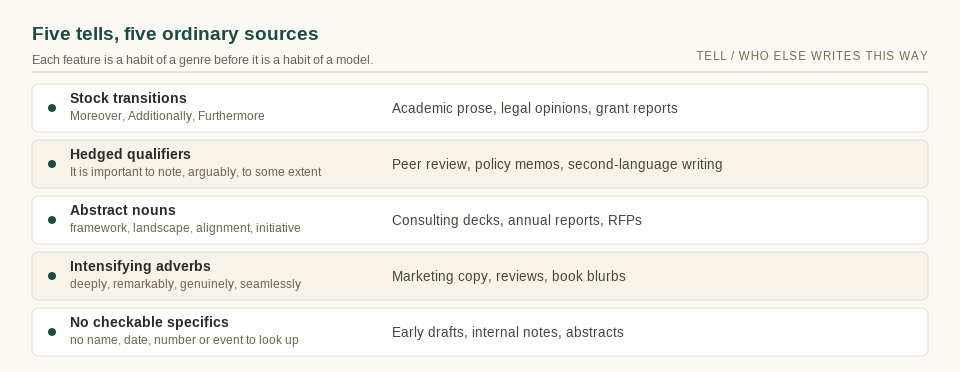
Each item is diagnostic of a genre before it is diagnostic of a model. Academic prose runs on transitions because a transition is the cheapest way to show that a sentence follows from the last one. Legal opinions hedge because the claim has to survive a case that does not exist yet. Consulting decks use abstract nouns because the deck has to apply to whichever client is in the room. None of that requires a language model. All of it produces text that a tell list would flag.
Why a checklist feels stronger than a word list
A word list is easy to dismiss, and people dismiss it correctly. One instance of "additionally" means nothing, and everyone has met a writer who uses it out of habit. The checklist is harder to dismiss because it counts several different things at once. Five items across five categories sounds like independent confirmation. It is not independent. The five items are correlated: the register that produces stock transitions also produces hedges and abstract nouns, because all three are consequences of writing for a general audience rather than a specific one.
So the count is closer to one measurement repeated five times than to five separate tests. A passage written in an elevated register will score high on four of the five without any of them adding information about who typed it. That is not a small statistical quibble. It is the difference between five witnesses agreeing and one witness saying the same thing in five sentences.
Where the overlap comes from
If you plotted the count of tells for a large set of human passages and a large set of model passages, the two shapes would sit on top of each other for most of their range. Model output clusters a little higher. Human output spreads wider, because human output includes more genres. The overlap is not a flaw in the list; it is what the list is measuring.
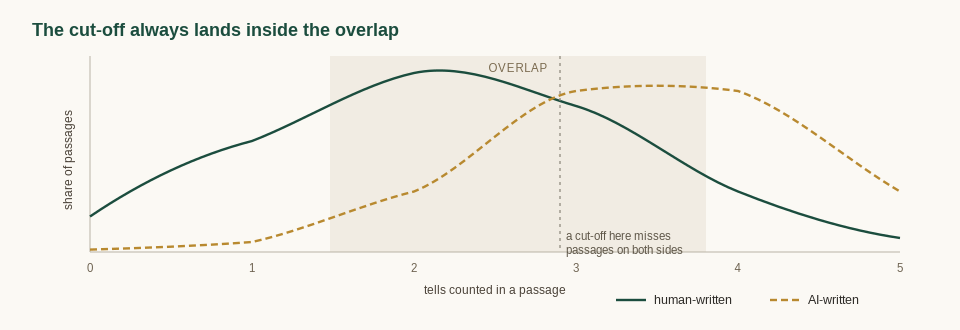
Any threshold you pick lands inside that overlap. Set the cut-off low and you flag edited human prose, second-language writing, and anything that went through a legal or grant review. Set it high and you miss model output that was cleaned before delivery, which is most model output that anyone bothers to send. There is no cut-off that separates the two groups, because the groups were never separated by this measurement.
What a high count licenses you to do
A high count is a reason to read more carefully. It is not a finding. The useful version of the checklist result is a question: which of these features is doing the work, and is there anything in the passage that could be checked? If the answer is that four items are present and nothing is verifiable, you have learned that the text is general. General text is cheap to produce, which raises the prior a little. It does not tell you who produced this one.
That distinction matters most in the situations where people actually reach for a tell list: a submitted essay, a freelance writing sample, a message from someone you have not met. In each case the checklist gives you a number that feels like a verdict, and the number is compatible with several explanations that have nothing to do with a model. The guide to what detectors can and cannot measure covers the same gap from the tool side.
Three things the list cannot see
Where the content came from. A paragraph with a date, a figure and a described event scores zero on the list and can still be model output, if the model was given those details. A paragraph with none of those scores high and can be a person thinking out loud. The list reads the surface; the question is about the source.
Structure. A tell list looks at sentences. The stronger pattern lives above the sentence: four paragraphs that open the same way, a section that restates its heading, a conclusion that announces an ending instead of producing one. Those are structural habits, and they survive a rewrite that removes every flagged word. The page on bullet points shows how far that goes: the same five sentences as a paragraph and as a list read as two different authors. The vocabulary page works through the same limit for individual words.
The kind of error. Typos and grammar faults are not on the list because they point the other way, and they are just as weak. A clean sentence proves an editor was involved. A typo proves nobody proofread. Neither proves a person composed the sentence. Our page on typos and the page on perfect grammar take the two halves of that pair.
Editing with the list, judging without it
The checklist is genuinely useful for one job: making a draft sound less like a template. Cut the connectors that only announce structure, replace abstractions with the specific thing you meant, delete adverbs that add emphasis without information, and add one verifiable detail per section. That is good editing advice regardless of who wrote the draft, which is the point. The list describes what flat prose looks like.
It is a bad judging instrument for the same reason it is a good editing instrument. Anything that can be fixed in one pass cannot be evidence of origin, because the pass removes the evidence without changing the origin. A writer who cleans a draft and a model asked to avoid the list end up in the same place: text with a lower score and the same author as before.
How this set was built
Designed November 4, 2026. The three passages were written for this exercise and are not quoted from anywhere; what each one demonstrates is the count, not its origin. The first case scores four of five and is built entirely from features that policy and academic writing produce. The second scores one of five and shows how cheaply a low score can be manufactured. The third scores zero and carries a date, a figure and an event, which is exactly the combination the list cannot evaluate. The exercise is about reading what a count can support, not about producing text that dodges a list.
This page is not an AI detector. It does not accept text, call a model, or score anyone. The three cases run only in your browser. Existing site analytics are described in our privacy policy.
Related reading and practice
AI writing questions, answered → · Does perfect grammar mean AI? → · Do typos mean human or AI? → · Do bullet points prove someone is AI? → · The one tell that was nearly proof → · Does agreeing with everything prove AI? → · Does a long answer prove AI? → · Does using big words mean AI wrote it? → · Does AI use contractions? → · Is the rule of three a sign of AI writing? → · Play the Human or AI game →