HUMAN OR AI · QUOTE CHECK
Human or AI: does citing a source prove someone is human?
No. A quote can be exact, clipped, translated or copied. It does not prove who wrote the text. Play six short cases and choose what the words support.
What do the words actually support?
Round complete
Does quoting a source prove someone is human?
No. A quote can make a claim easier to check when its speaker, wording, version and context are clear. It cannot show who wrote the message containing it.
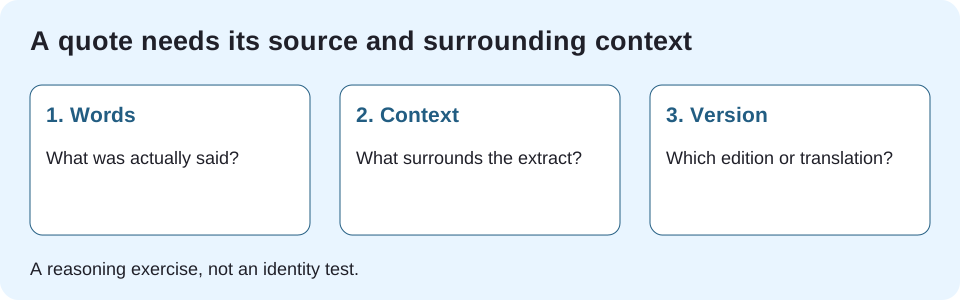
How to check a quote
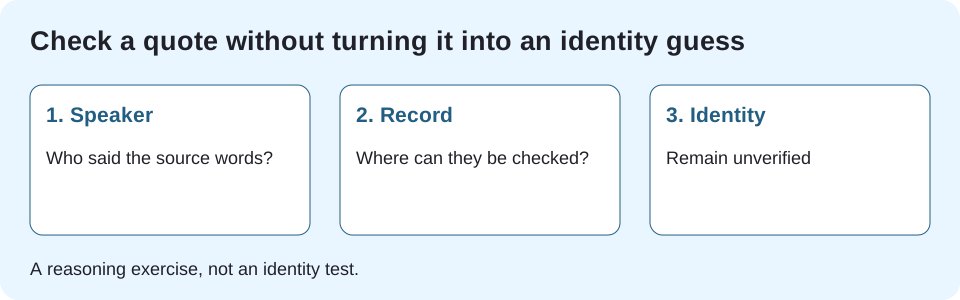
Locate the words. Keep the speaker, source, edition, time or timestamp that makes the wording traceable.
Read around them. Check qualifications, preceding sentences, translations and corrections.
Keep the boundary. A checkable quotation can support a claim. It does not identify whether a human or AI wrote a later message.
What quotation marks can and cannot tell you
Quotation marks may signal exact wording, a label, a paraphrase or an unattributed repost. They are a prompt to check the source, not an identity test. Respect privacy and seek public, shareable evidence rather than private messages.
How to play and read your score
Each round randomly selects six different cases from sixteen original fictional scenarios. A supported choice earns one point; other choices earn none. Choices lock after selection and feedback explains the quotation boundary. There is no timer or speed bonus.
0–2: Start by locating the speaker, version and surrounding words. 3–4: Some distinctions held; watch for paraphrase, clipping and translations. 5–6: You consistently kept quotation quality and authorship separate. These practice bands are editorial choices, not a validated measure of fact-checking or authorship detection.
Review all sixteen cases
Every case below is AI-assisted fiction written for this exercise. None is presented as a verified quotation, a real participant statement or a source finding.
The unattributed quotation
A message begins, “I never said that.”
No speaker, date or source is named.
Question: What is missing?
Supported choice: A traceable speaker and source context. Quotation marks show a claim is presented as a quote. They do not identify a speaker, source or author without further context.
The cropped sentence
A screenshot highlights one sentence from an interview.
The preceding sentence changes what “it” refers to.
Question: What should be checked?
Supported choice: The surrounding passage before interpreting the quote. A short extract can lose the referent and qualification around it. Context helps check the claim, not the writer.
The paraphrase in quotation marks
A post uses quotation marks around a loose summary.
The source uses different wording.
Question: How should it be labeled?
Supported choice: As a paraphrase, or replaced with the exact wording. A paraphrase can be useful when clearly labeled. Quotation marks should not imply exact wording that the source does not contain.
The quote card
A designed image shows a quote and a famous name.
It gives no source or date.
Question: What is the careful response?
Supported choice: Treat the attribution as unverified until a source is found. A polished quote card can still lack a checkable origin. Presentation quality is not evidence of authorship or accuracy.
The missing edition
A quote is attributed to a novel.
The book has several editions and translations.
Question: What would help locate it?
Supported choice: The edition, translator and page or chapter. A specific edition and location make a quote reviewable. They do not reveal who copied or wrote the message.
The clipped qualifier
The source says, “This may work in some cases.”
A message quotes only “This works.”
Question: What changed?
Supported choice: The qualifier and scope were removed. Removing conditions changes what a source supports. Check the full sentence and nearby context before drawing conclusions.
The translated line
A translated quote is presented as exact.
No translator or original-language version is named.
Question: What should be added?
Supported choice: The translation source and, when possible, the original context. Translations can be valuable, but versions matter. Naming the translation supports review without becoming an identity test.
The quote repeated everywhere
Four sites use identical quotation marks and attribution.
All trace back to one unsourced list.
Question: How many primary sources are visible?
Supported choice: None until an original source is located. Repeated wording can travel through copies. Count underlying primary evidence, not the number of reposts.
The interview timestamp
A video transcript includes a quote.
The transcript links to a timestamp in the full interview.
Question: What does the timestamp help with?
Supported choice: Checking the wording in its spoken context. A timestamp can make an extract easier to audit in context. It does not identify a later writer.
The anonymous message
An anonymous post quotes a public article accurately.
Question: What does the citation establish?
Supported choice: The article’s source, not the anonymous poster’s identity. An accurate quotation can support a source claim. It does not connect an anonymous message to a particular author.
The quote after a correction
A publication adds a correction below a quoted paragraph.
A later post shares the old wording alone.
Question: What should be included?
Supported choice: The correction or current version when relevant. Corrections can change how a quotation should be understood. Keep version history separate from authorship.
The quote inside a quote
A report quotes a spokesperson quoting another person.
Question: What should the citation distinguish?
Supported choice: Who said each layer and where it was reported. Nested quotations need clear attribution at each layer. That helps readers check the chain without inferring identity.
The headline as a quote
A headline uses quotation marks around a phrase.
The article body shows it is a label, not a direct statement.
Question: What is the next step?
Supported choice: Read the body before treating it as a direct quote. Headlines can frame or shorten language. The underlying article tells whether the phrase is a direct statement and in what sense.
The private-message request
A reader asks for private messages to prove an attributed quote.
Question: What is the appropriate boundary?
Supported choice: Seek public, shareable evidence instead of private messages. Source checking should respect privacy. A public record may support a claim; private material is not required to guess identity.
The unverified audio quote
A transcript claims a speaker said a line, but the audio is unavailable.
Question: What should be said?
Supported choice: The wording remains unverified without accessible source context. Without an accessible recording or reliable primary source, preserve the verification limit. Do not replace it with an identity claim.
The final quote question
The message has a precise quote, speaker, date and source link.
No author information is supplied about the message itself.
Question: What conclusion is supported?
Supported choice: The quote can be checked; message authorship remains unverified. A well-located quote helps evaluate a claim. It does not reliably determine who composed the message that contains it.
How this set was built
Design date: October 24, 2026. Sixteen original cases cover direct quotations, paraphrases, context clipping, editions, translations, corrections, source chains, timestamps and privacy boundaries. Each has three choices, an editorially supported answer and an explanation. The scenario count and score bands describe this game’s design; they are not research findings.
This page is not an AI detector. There is no text submission, source lookup, model call or identity result. Choices and scoring run in your browser. Existing site analytics are described in our privacy policy.
Related games and background
We carry forward the fixed comparison-site observation recorded on October 21, 2026: Human or Not begins with a short chat and ends with an identity guess. We use a task-first order, not its wording or live-chat function. Quote Check uses prepared cases to ask what a quotation can support.
Separate citations from authorship → · Separate current facts from authorship → · Check the homepage question sources →