HUMAN OR AI · TURING QUESTION SORT
What do Turing test questions actually test?
A capability, not an author. A question can show that something can be done. It cannot show what did it. The original test measured a judge’s uncertainty, and that is still all a transcript can give you.
What does this question test?
QUESTION 1
Choose the label that fits.
What the original test was
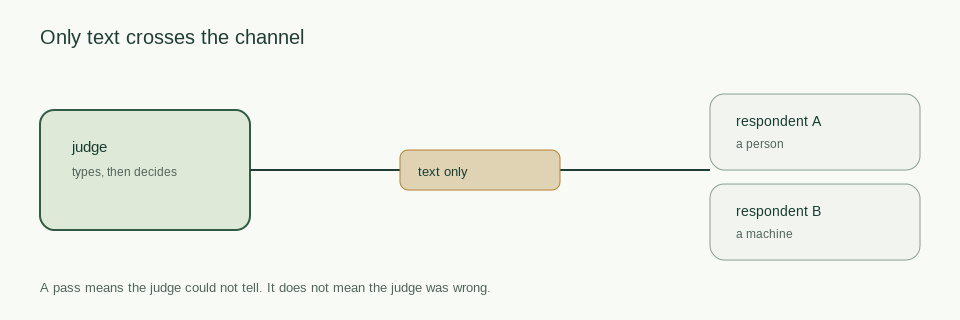
Alan Turing published “Computing Machinery and Intelligence” in Mind in 1950. He replaced the question “can machines think?”, which he treated as too vague to answer, with an operational one. A judge types to two unseen respondents, one a person and one a machine. If the judge cannot reliably say which is which, the machine has passed.
That is the whole design, and it is worth reading carefully. The instrument is not the machine. The instrument is the judge, working through a text channel, for a limited time, on a topic the judge chooses. Everything a Turing test can report comes from that arrangement.
Why the judge, not the machine, is the instrument
Two judges with different backgrounds can reach opposite verdicts on the same transcript, and both can be right about what they experienced. A judge who works with language all day notices different things than one who does not. A short session favours whoever is quicker to produce a fluent reply. A long session favours whoever can keep an account straight.
None of this is a contradiction. It is a property of a test that measures indistinguishability rather than origin. A pass means the judge could not tell. It does not mean the judge was wrong about the world, and it does not mean the responder is a person.
An annotated list of question types
People searching for Turing test questions usually want something they can actually use. The honest answer is that the type of question matters less than the shape of the exchange. Here is what each family can and cannot tell you.
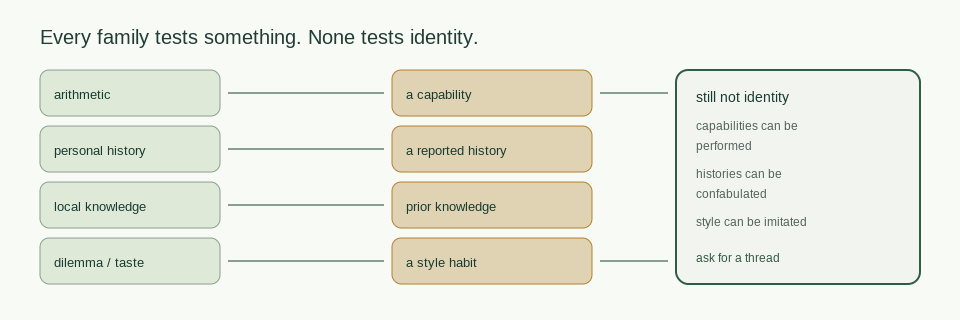
- Arithmetic and logic. Tests a capability. A correct answer shows the responder can compute. A wrong one shows it cannot, or that it made a slip. Neither outcome identifies the author, and this family lost most of its discriminating power years ago.
- Personal history. Tests a reported biography. A detailed answer can be invented, and confabulation is fluent. A vivid memory is weak evidence of having lived the thing.
- Specific local knowledge. Tests prior knowledge. A model may have it from training text, and a person may look it up mid-conversation. The answer tells you what is available, not who is present.
- Emotional or moral dilemma. Tests a style habit. Both people and models produce plausible, well-shaped answers, so the reply says more about the genre than about the responder.
- Multi-turn consistency. Tests the thread. This is the strongest text-only option, because it asks whether the account holds together across answers rather than whether one answer sounds right. It still only reports on the exchange.
- Instruction with a constraint. Tests control. Ask for a reply with no letter e, or exactly three sentences. Compliance is measurable, and it is still a capability.
What a question can never do
A single answer is one sample. Identity claims need provenance: who wrote it, when, with what tools, and with what record. A transcript has none of that. It has text, and text is the thing under examination.
This is the same problem that appears in very short samples, where there is simply not enough material for any cue to accumulate.
If you want to run one anyway
Ask for a thread, not a fact. Make each follow-up depend on an earlier answer, so an invented detail has to stay invented. Record the whole exchange rather than the verdict. Then write the result as what it is: the judge could not tell the two apart in this session, on this topic, for this long.
How to play and read your score
A round shows six questions, one at a time. Label each as a capability, a reported biography, or a style habit. A correct label earns one point.
0–2: in this round the labels ran together. Ask what a correct answer would actually demonstrate before you ask it. 3–4: you read most questions correctly but treated a reported history as evidence of a person. 5–6: you kept capability, biography and style apart. This score describes your choices in this round, not your ability to detect AI.
Question design and source notes
Designed October 27, 2026. The six questions and their explanations were written with AI for this exercise. They are illustrative, not excerpts from a real session, and no claim here rests on a measured pass rate.
The exercise is our editorial design, not a validated assessment. This page is not an AI detector. It does not classify submitted text and it does not connect you to another player.
Turing’s paper is Computing Machinery and Intelligence, Mind 59 (236), 1950. For a conversational version of the design, see Jannai et al., Human or Not? (2023); it is context for the format, not validation of this page.
Where to go next
- Build a question ladder for a live round of the game.
- See why generic questions fail and how to turn a dead end into a thread.
- Read how the questions on this site are made and what is deliberately left out.
- Compare this with a CAPTCHA, the other test that claims to separate people from programs.