HUMAN OR AI · CAPTCHA SIGNAL MATCH
Why do CAPTCHAs ask you to prove you are human?
Because they are reading a signal, not asking a question. Each puzzle measures something a script is bad at. Passing one shows that a signal looked human, not that a person is present.
What is this task reading?
TASK 1
Which signal does it read?
What the acronym means
CAPTCHA stands for Completely Automated Public Turing test to tell Computers and Humans Apart. The term was coined around 2000 by researchers at Carnegie Mellon. Every word in that name is doing work, and two of them explain why the puzzle stopped looking like a test.
Automated means no human judge sits at the other end. Public means the check has to run for anyone who arrives, at any hour, without a moderator. A test with no judge and no moderator cannot ask a question and evaluate an answer. It has to measure something a machine can score on its own, and what a machine can score is a signal.
The two jobs a CAPTCHA does
The first job is a gate: slow down automated form filling, scraping and credential stuffing. The second, in some early systems, was a label: the distorted words were scanned book text that the answers helped digitise, and the image grids helped annotate photographs.
Those jobs pull in opposite directions. A gate wants to be invisible, because friction costs the site real users. A label wants your attention, because the value comes from the work you do. Most of the visible puzzles you remember come from the second era, and most of the checks you never notice come from the first.
Why the puzzle is often not the test
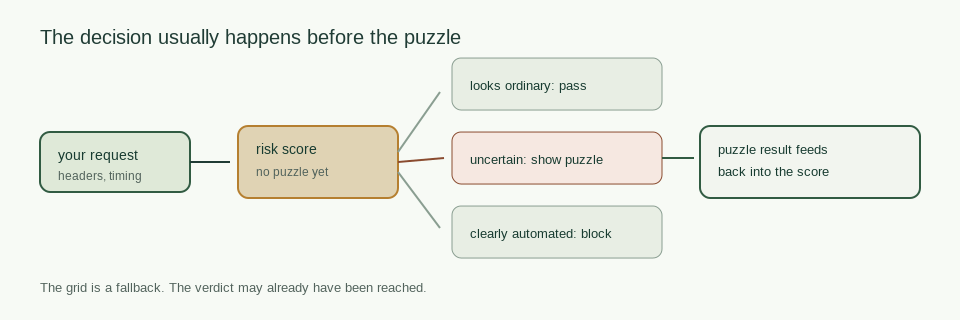
Modern systems score the request before you touch anything. They look at the reputation of the address, the shape of the browser fingerprint, the order of the request headers, how long the page has been open, and whether a pointer has moved at all. The puzzle appears when that score is uncertain, which is why the same site asks you nothing one day and three grids the next.
This is also why “I clicked all the traffic lights and it still failed” is a common experience. The grid may have been a fallback while the score was already decided. The visible task and the actual decision are not always the same event.
What a CAPTCHA cannot tell you
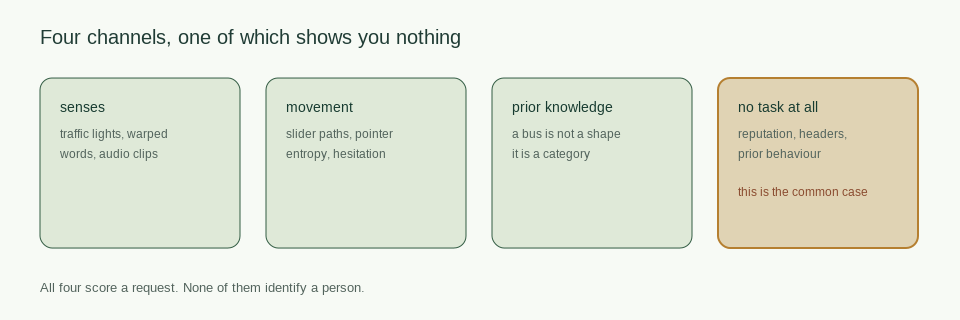
It cannot tell whether you are a person. It can only tell whether this request resembles earlier requests that were made by people. That is a statement about a pattern, not about a mind, and it is the same shape of claim that a text detector makes when it returns a number.
The structural problem is accessibility. A signal test excludes anyone whose senses, motor control, knowledge or language differ from the reference population the system was tuned on. The audio alternative exists for exactly this reason, and it tests the same underlying signal through a different channel.
“Prove you are human” is marketing language for “score one request”. Once you read it that way, the odd behaviour of these systems stops being odd.
Why this page exists
People search for a CAPTCHA test to try, sometimes for practice and sometimes for fun. The exercise below is not a CAPTCHA and does not gate anything. It is a matching drill: given a task, name the signal it reads. The point is to see the machinery, not to pass it.
How to play and read your score
A round shows six tasks, one at a time. Choose the signal each one reads. A correct match earns one point.
0–2: in this round the puzzle and the decision looked like the same thing. Ask what the system could measure without showing you anything. 3–4: you separated sensory tasks from behavioural ones but missed where the decision actually happens. 5–6: you read the request, not just the puzzle. This score describes your choices in this round, not your ability to detect AI.
Question design and source notes
Designed October 27, 2026. The six tasks and their explanations were written with AI for this exercise. They describe common patterns rather than the internals of any named product, and no claim here rests on a measured accuracy figure.
The exercise is our editorial design, not a validated assessment. This page is not an AI detector. It does not classify submitted text and it does not connect you to another player.
For the research context on how these signals diverge across writing groups, see Liang et al. (2023); it is background, not validation of this page.
Where to go next
- Compare this with the original Turing test, which used a human judge instead of a signal.
- See what a text detector is actually scoring and why its number is not an identity claim.
- Read why short samples carry so little evidence, which is the same problem in a smaller box.
- Play the Knowledge Check on whether a fact can prove an author.