HUMAN OR AI · VOCABULARY CHECK
Does AI overuse certain words?
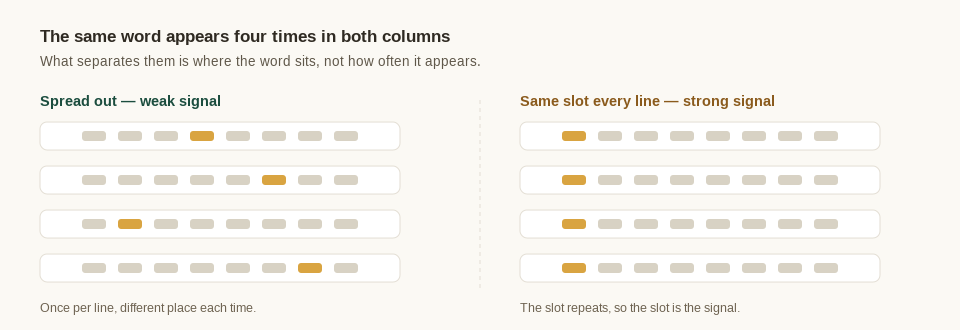
Yes, and the list is short and stable. Models trained on the same broad text end up preferring the same high-probability words: stock transitions, hedged qualifiers, abstract nouns and a small set of intensifiers. But knowing the list is the easy half. The word on its own tells you almost nothing, because careful writers, editors, translators and students writing in a second language reach for exactly the same vocabulary. What separates a habit from a fingerprint is how often a word returns and where it lands.
Mark the words you would flag
Case 1 of 3Loading · tap any shaded word to mark it.
Which words actually recur
The lists that circulate online differ in the details but agree on the categories. Five of them cover most of what people notice:
- Stock transitions. Moreover, furthermore, additionally, notably, importantly. These are ordinary in academic prose and ordinary in model output for the same reason: they are cheap ways to signal that a sentence follows from the last one.
- Hedged qualifiers. It is worth noting that, arguably, to some extent, in many cases. Hedging protects a claim. A model hedges because hedging is the safe continuation when it has no source to lean on.
- Abstract nouns. Landscape, realm, framework, approach, alignment, initiative, execution. These name categories rather than things, so they fit almost any sentence.
- Intensifying adverbs. Quietly, deeply, remarkably, genuinely, seamlessly. Adverbs that add emphasis without adding information.
- Closing formulas. In conclusion, overall, ultimately, at the end of the day. Phrases that announce an ending instead of producing one.
Why these particular words
A language model produces the most probable continuation given what came before. Averaged across an enormous amount of text, the most probable continuation in an explanatory paragraph is often a connector, and the most probable noun after "a robust" is often an abstraction. Nothing in the training process selects for elegance or specificity. It selects for likelihood, and likelihood rewards words that fit everywhere.
That is also why the list is stable across products. Two companies training separate models on overlapping text arrive at overlapping habits. If the vocabulary came from a brand voice or a prompt style, the lists would diverge. They do not, which is evidence that the cause is the training distribution rather than any one product's choices.
Why a word list is weak evidence
Every category above has a legitimate human source. Academic writing is built out of transitions and hedges. Grant proposals, policy memos and legal briefs run on abstract nouns because the abstract noun is the correct unit for the claim. A translator chooses the most reliable word rather than the most interesting one, because reliability is the job. A student writing in a second language does the same thing for a different reason.
The practical consequence is that a passage can be dense with flagged words and still be entirely human, and a passage can be free of every word on the list and still read as machine-written. Editing produces the first case constantly: someone writes a plain draft, an editor raises the register, and the result looks like a model wrote it. The guide to why human writing gets flagged covers that path in more detail.
Three things that carry more weight
If the vocabulary is the weakest signal, what is stronger? Three properties, and all of them are about arrangement rather than word choice.
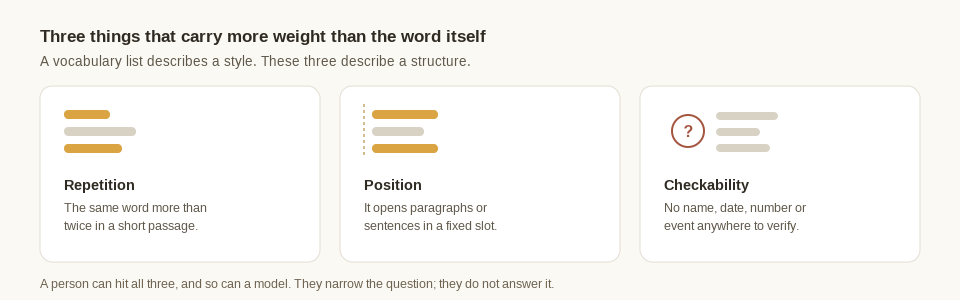
Repetition. One use of "additionally" is nothing. Four uses in four consecutive paragraphs is a pattern, and the pattern is what a template produces. Count the returns before you count the words.
Position. A word that always opens a paragraph, or always sits in the second sentence of a section, is filling a slot. Slots come from structure. People vary their openers even when they are writing quickly, because the variation costs nothing.
Checkability. Ask what in the passage could be verified: a name, a date, a number, an event someone could look up. Where none exists, the abstract vocabulary is a symptom rather than the cause. The prose has no content to be specific about, so it fills the space with categories.
What avoiding the words does not do
Swapping "additionally" for "also" and "landscape" for "situation" changes the surface and leaves the structure intact. If four paragraphs still open the same way and none of them contains a verifiable fact, the rewrite has not made the text more human. It has made it a version of the same text with a smaller vocabulary, which is a description of the problem, not a fix.
The same point applies to detectors. A tool that scores word frequency is measuring a real property of the text, and that property is easy to change without changing anything a reader would care about. Our guide to what detectors can and cannot do covers why that makes the score unstable.
How this set was built
Designed November 1, 2026. Each case is a short passage with the recurring words marked as tappable. Tapping marks a word; revealing shows what the passage actually demonstrates. The three cases are arranged so that the most heavily flagged passage carries the weakest signal and the passage with a single repeated word carries the clearest one. The exercise is about reading structure, not about producing text that avoids a list.
This page is not an AI detector. It does not accept text, call a model, or score anyone. The cases run only in your browser. Existing site analytics are described in our privacy policy.
Related reading and practice
Does AI repeat itself? → · Does AI use a lot of adverbs? → · Does AI use passive voice? → · Why human writing sounds like AI → · Is the em dash a sign of AI writing? → · Do bullet points prove someone is AI? → · Check your own writing for the usual tells → · Does using big words mean AI wrote it? → · Is the rule of three a sign of AI writing? → · Play the Human or AI game →