HUMAN OR AI · THE STRONGEST TELL
Does "as an AI language model" prove it's a machine?
Once, almost yes. Now, almost no — and the reason is the most useful thing on this site. Every other page here takes a weak tell and shows why it is weak. This one starts from the opposite end. Of all the phrases people cite as proof of a machine, this is the only one that was ever close to proof: it is a template a model emits about itself, with a fixed grammar and a fixed ending. Then people noticed. They quoted it, then joked with it, then put it in cover letters and captions and product pages. The sentence did not change. What changed is who has access to it, and that is enough to make the strongest tell in the language into a costume anyone can wear.
Four versions of the same sentence
0 of 4 readPick a year, read the passage, then say who wrote it. The verdict appears as soon as you choose.
2022 · first contact
I'm sorry, but as an AI language model, I cannot provide instructions for that. I'm unable to assist with requests that could cause harm.
This is the template in its original form: an apology, a self-description, a scope limit, a decline. Every part is doing the same job, which is to close the turn politely. Nothing here is a stylistic preference, and nothing here was chosen by a person.
2023 · the phrase becomes a joke
as an ai language model i cannot fulfill this request. anyway the meeting moved to four and dana is bringing the slides
Look at what happens after the refusal: the sentence keeps going, and it goes somewhere practical. A model's refusal ends the turn — that is the whole point of the template. Lowercase, no final punctuation, and a decoy refusal in front of a meeting time are three human decisions stacked in one line.
2024 · the phrase becomes irony
as an AI language model, I cannot attend your wedding, but I can RSVP with genuine enthusiasm and a gift from the registry
The joke only works because the writer knows where the phrase comes from. That knowledge is the evidence of a person. A model has no reason to describe itself as unable to attend a wedding, and no ability to find the mismatch funny.
2026 · the phrase becomes a genre marker
as an AI language model, I cannot taste this coffee. Our roasters can, which is why they cup every batch on Tuesday and reject anything that reads flat.
Brand copy using the template as a setup line. If you flagged this as machine-written you would be wrong about the author and right about the sentence's origin — and that gap is the entire problem with tells. The words came from a model once. The paragraph did not.
One phrase, four authors, and only the first one is a machine. If you scored three out of four, the miss was probably the last one, because the last one is designed to be missed: it is human writing that has learned to sound like the thing people are looking for.
Why the sentence exists at all
The phrase is not a habit. It is an artifact of how assistants are trained to handle requests they are not allowed to fulfil. A refusal has to do four things at once: acknowledge the request, explain the limit, decline clearly, and avoid implying that the limit is the user's fault. The cheapest way to satisfy all four is a fixed template, and a fixed template produces the same words in the same order every time.
That is why the phrase felt like proof. It was not a style that a model happened to prefer — it was a policy rendered as prose, emitted by the same machinery every time the machinery hit the same wall. Of everything on this site, this is the only tell with a mechanism behind it.
The four parts of the real template
If you want to recognise the genuine article rather than a quotation, look for all four parts in order: an apology, a self-description naming the system, a scope limit on what it can do, and a decline. Then look at what follows. This is the part people skip.
A model's refusal ends the turn. The template is a closing move, and the system that emits it stops. A human who borrows the phrase almost always keeps writing, because the refusal was never the point — it was a setup, a joke, or a way of clearing the throat before the actual sentence. Continuation is the single most reliable signal in the whole pattern, and it is not a property of the words. It is a property of what the words are doing.
The template has no inside. A model does not mention that it is declining reluctantly, or that the request was interesting, or that a colleague would answer it differently. A person quoting the template usually cannot resist adding one of those. The addition is human, even though every noun in the sentence came from a machine.
How the strongest tell became a costume
A tell works while it is obscure. The moment it becomes famous, two things happen at once: everyone learns to spot it, and everyone learns to use it. The second effect is the one that ruins the measurement, and it is the one people forget.
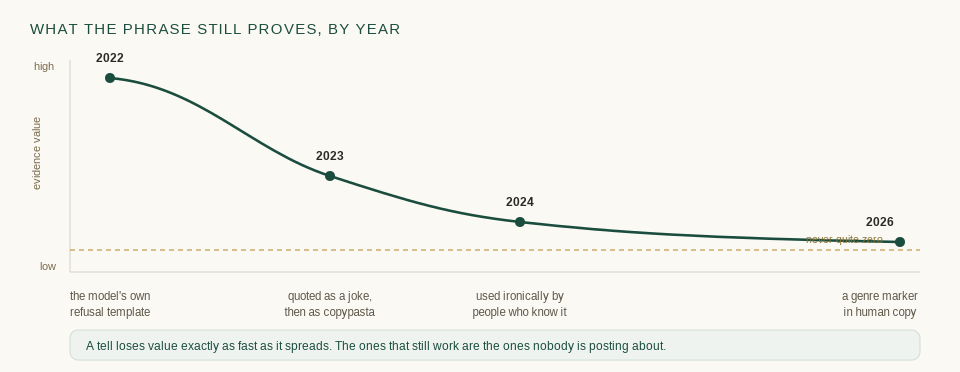
The phrase went through the sequence that every good tell goes through. First it was diagnostic, because only one kind of writer produced it. Then it was funny, because the mismatch between a machine's formal apology and a human situation was the joke. Then it was useful, because a brand could borrow the setup to sound self-aware. By the end it is a genre marker: its presence tells you the writer knows what a chatbot sounds like, which is close to the opposite of what it used to tell you.
The same decay has happened to every tell on this site. The em dash was a signal until it became a talking point, and now careful writers avoid it for the same reason they once used it. Bullet points read as machine output until enough people noticed, and now the list shape is neutral again. The pattern is not that tells are wrong. It is that a tell is a measurement of a population, and populations change when they learn they are being measured.
Three tests that still work on this phrase
Does anything follow the refusal? If the message continues into content the refusal was supposedly blocking, the refusal was decorative. A model that declines does not then help. A person who says "as an AI language model I cannot X" and then does X is making a joke, and jokes require an author.
Is the phrase load-bearing or quoted? In the real template the phrase carries the whole sentence: it is the reason for the decline. In borrowed usage the sentence would still stand if you deleted it. Try deleting it. If nothing is lost, it was decoration.
Does anything else in the message show awareness of the joke? A winking detail, an over-precise date, a registry reference, a brand doing a bit. Awareness of the phrase's origin is evidence of a person, because only a person has heard of the phrase.
What it still proves, honestly
If a message contains the full four-part template, in order, with no irony anywhere around it, and the turn terminates there, you are looking at the strongest evidence this site will ever tell you to take seriously. It is not proof of authorship, and it is close to proof of origin: that sentence was produced by a system trained to refuse in that shape.
But notice how narrow the claim has become. It says something about one sentence, not about the message, and nothing at all about the person who sent it. Someone can paste a model's refusal into a document, and then the origin is the model and the author is the person with the clipboard. That distinction is the whole subject of this site, and it is why the questions worth asking in a human-or-AI game are about what a message does rather than which words it contains.
The general law, in one line
A tell loses value exactly as fast as it spreads, because spreading is what teaches people to produce it. The tells that still work are the ones nobody is posting about — which means the useful skill is not memorising a list. It is noticing which features a writer could have chosen, and asking why they chose that one here. Our audit of the standard tell list runs the same argument across five features at once, and the typo page covers the mirror-image mistake: treating an error as proof of a person.
How this page was built
Designed November 6, 2026. All four passages were written for this exercise; the first imitates the standard refusal template and the other three imitate the ways people have since borrowed it. None is quoted from a real conversation or a real brand. The year labels mark stages in the phrase's public life, not the date of any single post. The exercise is about what a borrowed tell can and cannot tell you, not about catching anyone.
This page is not an AI detector. It does not accept text, call a model, or score anyone. The four cases run only in your browser. Existing site analytics are described in our privacy policy.
Related reading and practice
Do AI writing tells actually work? → · Do bullet points prove someone is AI? → · Do personal stories reveal who wrote them? → · Play the Human or AI game →