HUMAN OR AI · FORMAT AND STRUCTURE
Do bullet points prove someone is AI?
No, and the reason is uncomfortable for both sides of the argument. Model output does arrive as a list more often than human prose does, and that fact is real. It is also unhelpful, because a list is a shape that half the working documents in the world already have. Recipes are lists. Meeting notes are lists. Job posts, safety cards, resumes and slide decks are lists. What people notice when they open a chat window and see dots is not a fingerprint of a machine. It is the shape that any writer reaches for when they expect the reader to skim, and the machine reaches for it for reasons that have nothing to do with being a machine.
One paragraph, two shapes
prose · 0 of 5 lines as listDrag the slider from left to right. Each step converts one sentence into a list item. The words never change.
The quarterly review was moved to Thursday because two of the six regional leads were travelling. Nothing in the deck changed except the date on the title slide. Support asked for the new escalation path to be written down instead of explained on the call. The revised path adds one step and removes three. Anyone who has run this meeting will recognise the reason: the old path only worked when the same four people were in the room.
Characters of text: 0 · unchanged from 0 · line breaks and dots added: 0
That is the whole demonstration, and it is worth sitting with for a second. The paragraph and the list contain the same characters. Nothing was rewritten, summarised or generated. A presentation layer put a dot in front of each sentence and started a new line, and the result looks measurably more like machine output to almost everyone who reads it. The reading changed because the shape changed, and the shape was the only thing that moved.
Where the bullets actually come from
Model output is list-heavy for three concrete reasons, and none of them is a property of the writer being artificial.
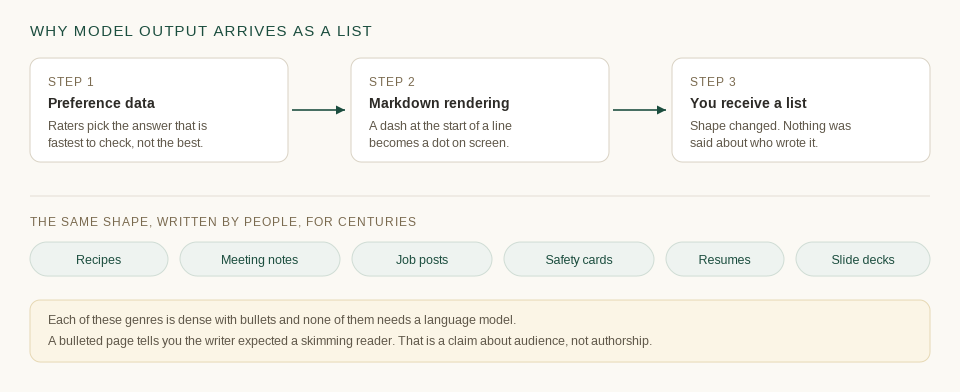
Answers are trained to be checkable. When people rank two model responses, they skim both and pick the one where the structure is visible. A response that announces three points and then makes them is easier to grade than a response that makes them in a paragraph. Training on those rankings produces a model that formats for the grader. The grader is a person in a hurry, which is the same person that recipe writers and product managers format for.
The interface renders structure whether or not the writer intended it. A line beginning with a dash or a number becomes a bulleted list in the client. The model emits plain text; the client decides that text is a list. Some of what people read as deliberate bullet-point style is a markdown convention applied downstream of the writing.
Lists are the cheapest way to look complete. A model that has four things to say and formats them as four bullets has produced something that scans as thorough. The same four things in a paragraph read as thin. That incentive is not unique to models, which is why the genre that invented the bullet point — technical writing — is also the genre most often accused of sounding generated.
The genres that are nothing but bullets
Open a cookbook. Every step is a line. Open the notes from any project meeting and the action items are a list with owners. Read a job posting and the requirements are bullets, because applicants scan for the three they meet. A safety card in an aircraft seat pocket is a numbered list with illustrations. A resume is a list of lists. A consulting deck is a list of lists rendered as rectangles.
These genres did not converge on the bullet by accident. They converged because a reader under time pressure needs to find one item and skip the rest, and a list is the only format that supports skipping. When you look at a bulleted page, you have learned that the writer modelled a skimming reader. That is a claim about audience. It is not a claim about who the writer was.
The tell is the kind of bullet, not the count
There is a real difference between machine-shaped bullets and human-shaped bullets, and it is not how many there are. It is what is inside them. Four patterns do most of the work.
Restatement. A bullet that repeats its own heading in sentence form. "Improved documentation: improved the documentation." The heading was the claim; the bullet adds no information to it. Human writers do this too, usually in a hurry, and it is the single most common complaint about generated text.
Uniform length. Five bullets of almost exactly the same character count. Real lists are lumpy, because real items differ in how much needs saying. One item runs long because it is complicated; another is four words because it is obvious.
Nothing checkable. No date, no number, no name, no place. A bullet that cannot be verified is a bullet that cannot be wrong, and text that cannot be wrong is cheap to produce. This is the pattern that overlaps most with corporate writing, which is why the accusation lands on both.
Order that does not matter. If the five bullets can be shuffled with no loss, they are not a sequence, not a priority, and not a set with dependencies. They are five independent claims wearing a list. A recipe cannot be shuffled. Neither can a set of directions or a bug report.
Click a bullet: what does it actually prove?
Five bullets in the style of a performance summary. Open each one to see what a reader can and cannot take from it.
-
No figure, no date, no system named. The sentence has the grammar of a result without any of the content of one. It could have been written by a person summarising a quarter from memory, or produced by a model given the phrase "throughput" and asked for an achievement.
Proves about authorship: nothing. Proves about the document: it was written to be skimmed.
-
Two figures, a metric name and a month. This is the only bullet in the set that a reader could go and check. It is also the only one that carries information rather than the appearance of it.
Proves about authorship: nothing. Proves about the document: whoever wrote it had access to the numbers.
-
Two abstractions joined by "and". There is no event, no counterpart, no outcome that could be observed. This exact sentence has appeared in annual reviews since long before anyone had a model to blame.
Proves about authorship: nothing. Proves about the document: the writer was filling a slot in a template.
-
A causal clause with an observation inside it. This is the shape people point at when they say a bullet "sounds human": slightly too specific, slightly informal, carrying a reason rather than a benefit. It is a good sign, and it is not proof. A model given the same context writes the same clause.
Proves about authorship: a little, in the sense that it is harder to produce without context. Proves about the document: someone was in the room.
-
The parody bullet, and the one most often quoted as proof of a machine. It is a real genre: it appears in decks, press releases and internal announcements written entirely by people, because the sentence has to survive being read by six departments at once.
Proves about authorship: nothing. Proves about the document: it was written for an audience that could not be offended.
Four of the five bullets above would be flagged by a tell list. One of them contains a checkable fact. The flagged four are also the four that a person writes when a template asks for achievements and the quarter was ordinary. The audit does not separate writers. It separates bullets that carry information from bullets that carry tone.
Why the count fails as evidence
Here is the part that is easy to miss. Suppose you knew that model output is bulleted far more often than human prose. That would still not tell you much about the bulleted page in front of you, because you also need to know how common bulleted pages are in the first place. In a genre where most documents are already lists — meeting minutes, requirements, safety instructions, resumes — a bulleted sample is the normal case, and the observation that it is bulleted is close to no observation at all.
This is the same arithmetic that makes a rare-disease test misleading. A test that is right almost every time still produces mostly false alarms when the condition is rare. Bullet points are the opposite: the condition is not rare, it is everywhere. The signal is weak because the base rate is high, and no amount of staring at the dots changes that.
What a bulleted answer does tell you
It tells you the writer expected to be skimmed. Sometimes that is a model formatting for a grader. Sometimes it is a colleague who has watched people ignore their emails. Sometimes it is a genre convention that the writer had no choice about, because the form asked for bullet points and a paragraph would have been rejected.
It also tells you something about what the document is for. A list is a set of items a reader is meant to act on separately: check this, do that, buy these. Prose is a set of claims a reader is meant to follow in order. When a document that should argue arrives as a list, the problem is not that a machine wrote it. The problem is that the writer did not decide what the reader should do, so they offered everything at once.
How to read a bulleted document without guessing
Stop counting dots and start looking for the item that does not fit. In a human document there is almost always one bullet that is longer than the others, or one that introduces a condition, a name, or a number nobody asked for. That bullet is where the writer was actually thinking. In a document assembled to look complete, every item sits at the same altitude and none of them commits to anything.
Then ask the two questions that survive every format change. Can I check any of this? And does the order matter? A document with one checkable item and an order that matters is a document someone built. A document with no checkable items and an order that could be shuffled is a document someone filled. Neither answer identifies a machine, and both tell you whether the page is worth your time. The page on overused vocabulary makes the same argument one level down, at the scale of single words, and the page on the em dash covers the punctuation version of this mistake.
How this page was built
Designed November 5, 2026. The paragraph in the slider was written for this exercise and is not quoted from anywhere; the slider changes only CSS classes, so the character count stays fixed by construction and the meter above reports the live count as proof. The five bullets in the audit are written in the style of a performance summary and are not taken from a real one. The point of the exercise is that the shape is free to change and the author is not.
This page is not an AI detector. It does not accept text, call a model, or score anyone. Both exercises run only in your browser. Existing site analytics are described in our privacy policy.