HUMAN OR AI · THE CONTRACTION TELL
Does AI use contractions?
Contractions are the cheapest register dial English has. Two letters and an apostrophe move a sentence from a form into a message, and almost nothing else about it changes. So when a reply arrives carrying none of them — no it's, no don't, no we'll — readers treat that as evidence of a machine, on the reasonable ground that a person writing to a person relaxes somewhere. The observation is real. What it identifies is the register the writer chose, and a register is a decision about a reader, not a property of a species.
One paragraph, seven settings
0 contractionsSix sentences that answer one question. Drag the dial and watch which of the three numbers responds. The claims in the paragraph are the same at every setting.
- It isIt's not a good week for me.
- I wouldI'd rather move it to Thursday.
- That does notdoesn't work for Sam either.
- We cannotcan't do Friday at all.
- You areYou're welcome to send the notes instead.
- I willI'll check with the team and confirm.
Zero contractions. Word count 44, and the register is the one an exam paper uses. Nothing in the paragraph is unclear — but it is being addressed to an institution rather than to a person.
Current register: a formal notice
What the dial actually measures
Move it and two numbers respond. Contractions rise from zero to six, and the word count falls by exactly one each time, from forty-four to thirty-eight. The third number does not move at all, because the paragraph makes the same three claims at every setting: the week is bad, Thursday is better, the notes will do. Six words were removed and not one of them was carrying information.
What the dial moves is distance. At zero, the paragraph is addressed to an institution. At six, it is addressed to a colleague who will answer you back. The content is identical in both, which is exactly why the test is weak: a feature every writer can turn, and turns depending on who is reading, cannot identify who is writing.
Why the machine's default sits low
Three pressures, and none of them is a limit.
The first is the training text. Most of what a model learns from is published and edited prose, and edited prose loses its contractions on the way to print. The model is not being taught to avoid them; it is being taught by text in which they are already mostly gone.
The second is the unknown reader. When you cannot see who you are writing for, the formal register is the safe one, because formality is rarely punished and informality sometimes is. A model begins every conversation without a reader, so it begins formal.
The third is preference tuning. Raters asked which of two replies is better tend to reward the one that sounds careful and professional, and "professional" in English means the register with the contractions taken out. The default is learned from the raters as much as from the corpus.
Notice what kind of claim that is. It describes a default setting, and settings are shipped, versioned and changed. Ask a current assistant to write casually and it will contract freely; several of them already do by default in conversational modes. The claim "AI does not use contractions" is therefore a claim about a particular product at a particular time, which is the weakest kind of claim available. The page on answer length makes the same argument about a different setting.
Who else writes at zero
An exam candidate, because the rules say so. A solicitor, because a contract that says don't is a contract someone will argue about. A translator, because the source was formal and reliability beats naturalness. A student writing in a second language, because the textbook form is the one they were marked on. Anyone writing upward — to a landlord, an insurer, a visa officer, a manager — because dropping the register is the risk. And anyone writing a report for a client, where the whole point is to sound like a firm rather than a person.
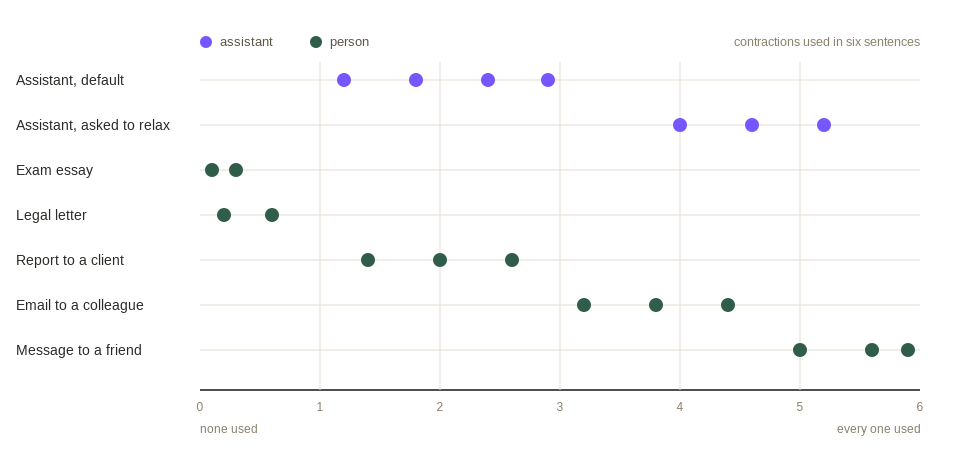
Read the plot as a test would have to read it. For contractions to identify a writer, the two groups have to occupy different regions. They do not. The assistant appears twice and lands in two different places, and the human samples cover the axis from zero to six. Any threshold you draw through that picture will put people on both sides of it.
The signal that survives: a text that cannot hold one register
Here is the version with some diagnostic value. Not the presence of contractions, and not their absence, but inconsistency between the register of the words and the register of the grammar. A paragraph with casual vocabulary and zero contractions. A paragraph with formal, nominalised vocabulary and six of them. Both read oddly, and both are what a second pass produces — someone drafted in one register and then edited toward another without going back through the whole text.
That is a real signal because it is a signal about process rather than identity. It tells you the text has been through two hands, which is often true of machine output that a person has tidied, and also true of a person who wrote a draft at midnight and edited it for a submission in the morning. So even here the honest reading is a cluster, not a verdict. It is a reason to ask a question, not a reason to make an accusation.
Three checks that survive
Does the register stay put? Read the whole text and mark where it changes. One change is a draft boundary or a change of reader. Three or four changes in a page is a text assembled from pieces.
Does the contraction land where the sentence is personal? People contract I am and we will far more readily than they contract a clause about a department. If the contractions are spread evenly across self-reference and institutional statements alike, the choice was not made sentence by sentence.
Would this reader have been contracted to? If the text is addressed to someone the writer plainly knows, and it still refuses every contraction, the care is aimed at the reader rather than caused by the topic. That is worth noticing, though it is also what a careful person does when they are unsure of their footing.
What it still proves, honestly
The narrow claim that holds: a text with no contractions, casual vocabulary, no self-reference and a peer for a reader is a weak cluster. Each part is weak alone, and the combination describes a text that has been made careful without being made personal.
What does not hold is the version people actually use, which is that a missing apostrophe means a machine. Zero contractions is a genre. Six contractions is a genre. The same writer produces both, and the choice between them is made about you.
How this page was built
Designed November 12, 2026. The six sentences were written for this exercise around an ordinary scheduling problem, and each has exactly one contraction available so that the dial has seven honest stops rather than a made-up scale. The word count and the register labels are arithmetic and a lookup table in the script; the claims are fixed text because the claims do not change.
This page is not an AI detector. It does not accept text, call a model, or decide who wrote anything. Existing site analytics are described in our privacy policy.
Related reading and practice
Does using big words mean AI wrote it? → · Does a long answer prove someone is AI? → · Does perfect grammar mean AI? → · Do AI writing tells actually work? → · Does AI use the Oxford comma? → · Play the Human or AI game →