HUMAN OR AI · THE SERIAL COMMA
Does AI use the Oxford comma?
Yes, usually — and that is one of the least useful facts in this whole argument. The comma before the final and in a list of three is the most machine-looking punctuation mark in English right now. Assistants produce it so reliably that people have started using it as a tell: if the comma is there, a model probably wrote it.
The observation is accurate. The inference is not. This particular mark is not a habit, a preference or a reflex. It is a line in a published rulebook, and the rulebook is freely available to anyone, including to people who have never touched a model.
This one is a rule, not a habit
Most of the things people call AI tells are tendencies. A model leans toward formal register, or toward long answers, or toward a certain vocabulary. Those leanings come from training distributions, so they are fuzzy and they move between versions.
The serial comma is different in kind. Style guides issue a binary instruction about it. Some require it in every series of three or more. Some omit it in a simple series and keep it only when leaving it out would cause confusion. An editor at a newspaper, a student submitting to a department, a lawyer filing a document and a language model all land on one of those two settings — and the reason any of them lands there is a document they could show you.
That makes this mark unusually easy to reason about. A tendency can be measured but not looked up. A rule can be looked up, and once you have looked it up, the mark has told you everything it is capable of telling you. It has named a convention. It has not named a writer.
The switch that actually matters
There is one thing the comma genuinely does, and it is worth seeing clearly before dismissing it: it tells the reader how to group the items. Take one sentence with two possible meanings and two possible handbooks.
One sentence, two switches
AP · three separate itemsChoose a handbook and choose what the writer meant. The sentence changes by at most one character, and the four cells below can be clicked directly.
Style guide
What the writer means
The dedication thanks my sisters, Ada, and Grace.
Intent missed. Without the final comma, the reader takes Ada and Grace to be the sisters — two people rather than three separate items. AP itself permits the comma here when leaving it out would confuse, so the rule bends to the meaning rather than the other way round.
The AP-style fix is either the clarity exception (keep the comma) or a rewrite: The dedication thanks my sisters, along with Ada and Grace. Both change the sentence, not the writer.
What the four combinations show
Two of the four say what the writer meant. Each handbook wins one and loses one. The comma is not a mark of correctness, a mark of care or a mark of machinery — it is a grouping instruction, and whether it is the right instruction depends on what the sentence is trying to say.
Notice what happens in the two losing cells. One can be repaired by invoking the clarity exception that the omitting handbook already contains. The other cannot be repaired by any handbook at all, because the relationship between the items is wrong for the punctuation. The fix is to rewrite the sentence. In other words: the moment the comma matters, the question stops being about punctuation and becomes a question about meaning.
That is the honest answer to "does a machine use the Oxford comma". A machine usually does. A person following Chicago usually does. A person following AP usually does not. A model told to write AP style usually does not either. Four writers, two settings, and the setting is decided before anyone knows who is writing.
Where the guides actually differ
The common summary is that the Chicago Manual, APA and MLA require the comma in a series of three or more, while AP generally omits it in a simple series and keeps it when omitting it would confuse or when the items are complex. The mark is called the Oxford comma because of the Oxford University Press tradition, not because Oxford invented it.
Those are rules of the trade, not findings about models. They were being argued about in newsrooms and publishing houses long before the current question existed. If a comma in a sentence can be traced to a clause in a handbook, the comma is evidence that someone was following a handbook — which is a claim about editing, not a claim about species.
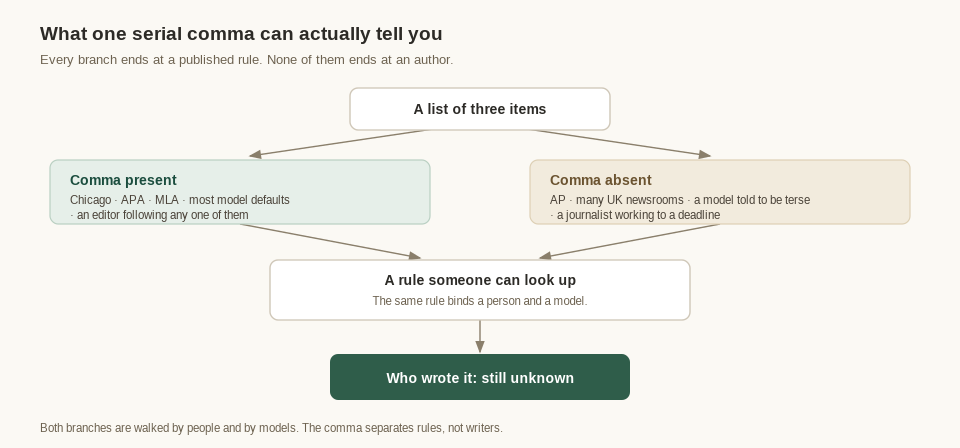
Read the chart as an inference chain. Every step is valid and the last step is where people jump. From the comma you can get to a convention. From the convention you cannot get to an author, because both branches are walked by both kinds of writer.
Why a model defaults to the comma anyway
Three pressures, and none of them is a fingerprint.
The first is the training text. Edited, published prose is over-represented in what a model learns from, and edited prose is produced under exactly those handbooks that require the comma. The model is not deciding to be formal; it is reproducing the punctuation of the documents it saw most.
The second is the absence of a house style. A human writer usually has a document telling them which guide applies. A model begins each conversation with no such document, so it falls back on the most frequent pattern in its training text. Give it a house style and it will follow the other one.
The third is preference tuning. Raters asked to choose the better of two replies reliably reward the one that looks carefully edited, and "carefully edited" in English is often the version with the comma in it. The default is learned from the raters as much as from the corpus.
All three describe a default setting. Defaults are shipped, versioned and changed. Ask a current assistant for AP style and the comma disappears in the same sentence, from the same model, with the same author — if a model can be said to have one. The page on contractions makes the same argument about a different dial.
The observation that is worth keeping
There is a version of this tell that carries a little information, and it is not about the comma itself. It is about inconsistency. A document that omits the serial comma in nine lists and keeps it in the tenth, with no change in the item structure, has been through two editorial regimes. One paragraph was pasted from somewhere else, or one section was edited under a different guide, or one model produced part of the text and another produced the rest.
That is a real signal because it is a signal about process, not identity. Two hands are visible. It is also what a person does when they combine a drafted section with a quoted one, or when a colleague edits half a report on a train. So even here the honest reading is a reason to reread the document, not a reason to make an accusation.
Three checks that survive
Which guide is this document following? If you can name it, the comma has been fully explained and there is nothing left to infer. If you cannot name it, you have found an inconsistency, not an author.
Are the items on the same level? This is the question that actually decides whether a comma is needed. It requires reading the nouns. No amount of punctuation counting substitutes for it.
Does the choice stay put? One deviation is a paste boundary or an edit. Uniform adherence across a long document tells you the text was checked against a standard, which is something people and models both have done to them.
What it still proves, honestly
The narrow claim that holds: a text that follows one handbook with unusual consistency has been systematically edited. That is a claim about the process, and it is compatible with a careful person, a careful model, or a person cleaning up after a model.
What does not hold is the version people actually use, which is that the comma before and identifies a machine. That comma is a published instruction. It separates two ways of grouping a list, and the choice between them belongs to the reader the writer had in mind — plus, occasionally, to a copy desk with a rulebook and a deadline.
How this page was built
Designed November 15, 2026. The dedication sentence was written for this exercise so that both readings are live at once. The two settings, the four combinations and the eight-word count are fixed text and a lookup table in the script; the sentence never changes by more than one character. The statements about style guides are the common summary of widely published rules, offered as an orientation rather than as a quotation from any one edition — check the current edition of the guide that applies to you before relying on it.
This page is not an AI detector. It does not accept text, call a model, or decide who wrote anything. Existing site analytics are described in our privacy policy.
Related reading and practice
Does AI use a lot of semicolons? → · Is the em dash a sign of AI writing? → · Does perfect grammar mean AI? → · Is the rule of three a sign of AI writing? → · Do AI writing tells actually work? → · Play the Human or AI game →