HUMAN OR AI · THE VOCABULARY TELL
Does using big words mean AI wrote it?
Vocabulary is the tell people trust most and can defend least. A formal word is visible, countable, and easy to point at, so it becomes the evidence: the answer says leverage instead of use, therefore a machine wrote it. The observation is usually correct. These systems do reach for the latinate option far more often than a person does in conversation. What it measures, though, is not who wrote the sentence. It is how much the writer wanted to be taken seriously.
There is a real difference between human formality and machine formality, and it is not in the count. It is in the shape. A person's register moves: plain while describing, formal the moment a claim needs defending, plain again once the point is made. A model's register does not move, because nothing in a single turn gives it a reason to.
Four big words, two shapes
clusteredEight sentences answering one question, and exactly four formal rewrites to place among them. Switch the placement and watch which number moves. Tap any bar to read that sentence in its current form.
[[Ascertain]] the [[component cost]] [[prior to]] arriving at a [[determination]].
Four formal rewrites, and all four sit inside the four sentences that carry the decision. Sentences one to three stay plain because nothing is being defended yet. The register climbs exactly where the writer starts making a case, which is the one thing a model has no reason to do.
The number everyone counts is the one that cannot tell them apart
Run the chart in both modes and read the two figures that do not move: four big words, average register 2.0. Both arrangements produce them, because both arrangements contain the same four formal sentences. A word list, a formality score, a vocabulary-size estimate, a readability formula — every tool that reduces a text to one number returns the same value for a paragraph that relaxes into plain speech halfway through and a paragraph that never relaxes at all.
The figure that moves is the longest stretch of plain sentences: three in the clustered version, one in the spread version. Nothing was added or removed to change it. The only difference is where the formal sentences were allowed to land.
That is the whole argument of this page in one line. The property people measure is constant across the two writers, and the property that separates them is one nobody measures.
Register is a response, not a habit
Formality is situational for a person. You write plainly while explaining what happened, and the register climbs the moment you start defending a decision to someone who might disagree. It climbs again when the reader has power over you — a landlord, an insurer, a hiring manager, a visa officer. Then it drops back to plain the instant the risky part is over, often mid-paragraph, often with an apology for the long words.
A model has one register per reply. It does not notice that sentence four is now making a claim that could be argued with, because noticing would require having something at stake. So its formality is flat across the whole turn: every sentence sits in the same medium-formal band, including the ones that are only restating the question.
That flatness is what people are reacting to when they say an answer "sounds like AI". Not the size of the words. The fact that the size never changes. And the fix people reach for — cutting the big words — treats the symptom, which is why editing a machine answer to sound human mostly produces a shorter machine answer.
Six strips, one machine
Here is the problem with treating flatness as a signature. Uniform formal register is not rare. It is what writing looks like whenever the writer has decided in advance that the whole document has to be careful, and people make that decision constantly.
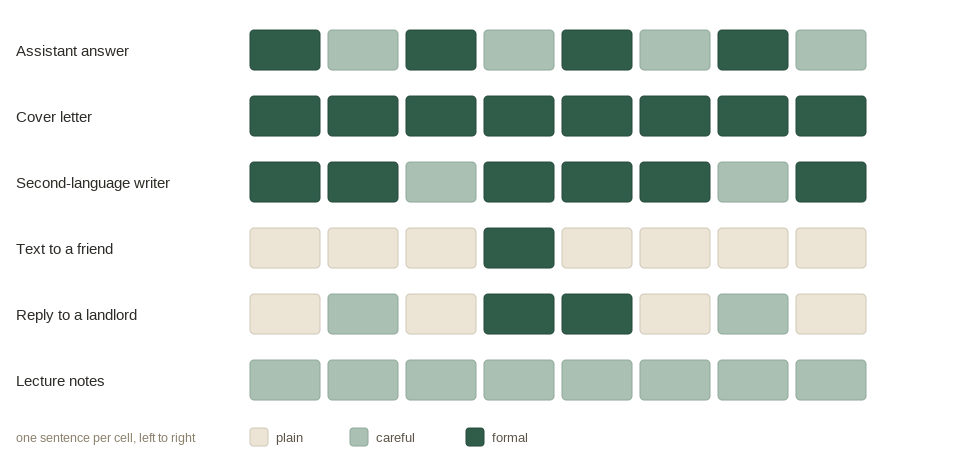
Only the first strip came from a machine. The cover letter is dark end to end because a cover letter is a performance from the first word to the last, and the writer knows it. The second-language writer learned the formal register first — from textbooks, from exams, from a school system that rewarded it — so it is their default rather than their exception. The lecture notes are uniformly careful because the lecturer is writing for an audience that will read them without the tone of voice that would otherwise carry the meaning.
Three of those six are flat and formal. One of them is a machine. If your test says flat and formal, you have found four suspects and no answer.
What a big word is actually doing
There is a reason vocabulary became the proxy in the first place, and it comes from signalling. When a reader cannot check your competence directly, they look for something costly that a fraud would not bother to fake. A precise technical word is exactly that: it takes years to acquire, it is hard to deploy correctly, and using it wrongly is more embarrassing than not using it at all. So the word functions as evidence of the training behind it.
The trouble is that the signal and the thing signalled can be separated. Once readers reward vocabulary, writers can produce vocabulary without the training, which is what a thesaurus is for. That is the origin of the feeling people describe as pretentious: the word is aimed at the reader's impression of the writer rather than at the topic. You can hear the aim. It is the difference between the battery is depleted said by someone who has tested it and the same sentence said by someone who wanted the sentence to sound expensive.
A model's big words are aimed at nothing. There is no reader to impress and no doubt to head off, so the formality is not a move in a social game — it is just the average of its training text. That is why the same word reads hollow from a machine and pretentious from a person: same vocabulary, different addressee. And it is why vocabulary size, on its own, tells you almost nothing about which of the two you are holding.
Three checks that survive
Does the register ever drop? Look for one plain sentence, not one plain word. A person who has been writing carefully for a paragraph will usually let go somewhere — a short flat sentence, a dash of ordinary speech, a "so". A model asked to be clear stays clear; a model not asked stays level. The absence of any drop across a long answer is the weakest but most reliable of the three signals here.
Is the big word doing work? Replace it with the plain word and see whether the claim changes. If nothing changes, it was decoration. If the claim becomes vaguer or wrong, it was precision, and precision is not a species marker. This test has the useful property of working on any text by any author, which is more than can be said for most of the list.
Does it get simpler for the reader? A writer with a model of the reader will simplify when the reader needs it and complicate when the reader can take it. A model produces the same band for a beginner and an expert unless it has been told which one it is talking to. Watch for the moment a text should have simplified and did not.
Who this will wrongly accuse
Anyone who learned the formal register before the casual one: second-language writers whose first English was textbook English, people educated in systems that marked formality as competence, and anyone who moved from a profession into a field where plain speech is expected and never quite lost the old habit.
Anyone whose discipline requires hedged, nominalised prose: law, medicine, insurance, academic abstracts, grant applications, and the entire genre of the corporate memo. These are not people trying to sound clever. They are people writing in a register their reader will accept as competent, and the register is a condition of being read at all.
Anyone writing upward. A message to someone with power over your housing, your visa, or your job will be formal throughout, with no plain run, because dropping the register is the risk. The test would flag every one of these writers, and every one of them is a person.
What it still proves, honestly
The narrow claim that holds: a long text with uniform formal register, no plain sentence anywhere, big words attached to no reason, and no simplification for a reader who plainly needed it, is a weak cluster. Each part is weak alone. The combination describes a text optimised for coverage and for sounding careful to nobody in particular.
Notice what that claim is about: the whole text, not any single word. No individual big word carries any information about authorship, which is exactly why the vocabulary check that people actually run — count the fancy words, decide — fails on both sides. It misses the machine that writes plainly. It convicts the applicant who cannot afford to.
How this page was built
Designed November 11, 2026. The eight sentences and both versions of each were written for this exercise; the formal rewrites are deliberate parodies of a register, not quotations from any product. Biennium is in there on purpose — it is a real word, correctly used, and almost never the right one, which makes it the cleanest example of formality as decoration rather than precision.
The chart runs on a fixed array in your browser. No text is accepted, sent, or scored, and the readout is arithmetic on eight numbers that are already in the page.
This page is not an AI detector. It does not accept text, call a model, or decide who wrote anything. Existing site analytics are described in our privacy policy.
Related reading and practice
Does AI use passive voice? → · Does AI overuse certain words? → · Does perfect grammar mean AI? → · Does my writing sound AI? → · Do AI writing tells actually work? → · Does AI use contractions? → · Does AI use the Oxford comma? → · Play the Human or AI game →