Case 1 · a model
The update improves , , and .
Cut one item to test the triple.
HUMAN OR AI · THE RULE OF THREE
Ask a room what gives a machine away and someone will say it: everything arrives in threes. Three examples, three benefits, three adjectives, three bullet points that could have been two. The observation is common enough now that the triple has become a joke in its own right, and jokes are usually right about the surface.
But this one has an awkward problem. The rule of three is older than every computer ever built, and no model discovered it. It was discovered by people who needed to be remembered.
Three is the smallest number that can hold a pattern. Two items read as a comparison; four read as a list. Three is the shortest sequence in which the ear hears a shape complete itself — the first item sets a rule, the second confirms it, the third closes it. It is also the most that working memory holds without strain, which is why a phrase in three parts can be repeated back after a single hearing.
That is a fact about attention, not about silicon. The consequences are all over the historical record. Veni, vidi, vici. Life, liberty and the pursuit of happiness. Blood, sweat and tears. Location, location, location — a triple with one item said three times, which still works, because the shape is doing the work and the content is almost incidental.
Every one of those was written by a person, for people, centuries before the first model existed. If producing threes were evidence of machinery, the entire history of public speech would be evidence of it.
There is a real difference, and it is not the count. A closed triple accounts for the whole space: the three items together cover it, so nothing is missing and nothing is repeated. A padded triple samples a space: three items are offered as examples of something larger, and the third is often a summary of the first two rather than a third member of the set.
You can test that without knowing who wrote anything. Cut an item and read the sentence again. If a fact left with it, the item was carrying information. If the sentence still says everything it said before, the item was rhythm.
Six triples below. The labels are hidden until you have tested all six, because the labels are the thing you are supposed to be testing.
Click any item to remove it. Then reread the sentence and decide honestly whether a fact left with it.
Case 1 · a model
The update improves , , and .
Cut one item to test the triple.
Case 2 · a person
We will , we will , and we will .
Cut one item to test the triple.
Case 3 · a person
, , then .
Cut one item to test the triple.
Case 4 · a model
We are excited to announce a , , and experience.
Cut one item to test the triple.
Case 5 · a model
The export fails only when the file is , , and .
Cut one item to test the triple.
Case 6 · a person
, , and .
Cut one item to test the triple.
All six tested. Three were written by a model: the release note, the launch copy and the bug report. Their carrying counts are 2, 1 and 3. The three written by people scored 2, 1 and 3 as well — the same three numbers, in a different order.
Sort the six by how many items carry information and the sources do not sort with them. The model's three scored 2, 1 and 3. The people's three scored 1, 3 and 2. Identical sets, and the most closed triple in the batch is a bug report written by a model while the least closed is a campaign speech written by a person.
That result is not a measurement of the world. The six cases were written for this page, so the match is a match I arranged. What it demonstrates is that the arrangement is available: a model can close a triple and a person can pad one, and the number of carried items will not tell you which is which even when you hold the answer key.
The reason it is available is that padding is not a property of writers. It is a property of genres. A speech pads because rhythm persuades and nobody audits a slogan. An ad pads because the third adjective is free. A launch note pads because it is written to sound finished rather than to be checked. A recipe does not pad, because a reader who follows a padded recipe ruins the cake and says so.
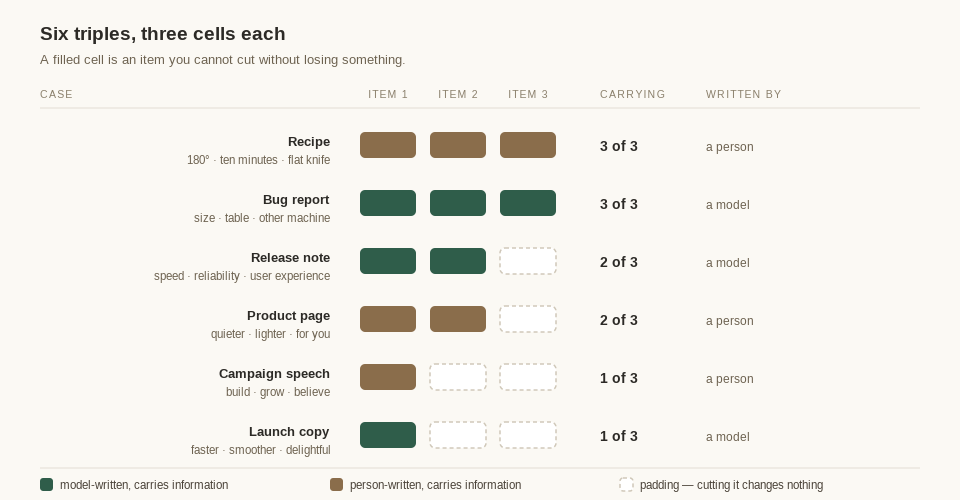
Read the figure downward. The two closed triples are a recipe and a bug report — one person, one model. The two fully padded triples are a campaign speech and launch copy — again one of each. What separates them is not who wrote the sentence but whether anyone downstream would have to act on it.
This is the useful version of the rule. When a triple sits in a text that will be checked — a procedure, a diagnosis, a set of conditions for reproducing a fault — padding is expensive, and it gets edited out. When a triple sits in a text that will be felt — a pitch, a toast, a product page — padding is the point, and it gets added on purpose.
Models are trained on both kinds of text, which is why their triples land in both registers. What they do not reliably do is check closure, because checking closure means asking whether the third item is a member of the set the first two established, and that is a question about meaning rather than about likelihood.
The signature is therefore not "three items". It is a third item that names the category instead of joining it. Speed, reliability and overall user experience: the first two are properties of the software and the third is the name of the bin the first two go into. Faster, smoother and more delightful: the first has a number behind it, the other two have nothing.
A person produces that too, and does, constantly, in exactly the genres where nobody checks. Which is why the tell works in a press release and fails in a bug report.
Cut each item and reread. Not skim — reread. The test only works if you are honest about whether a fact left the sentence.
Ask whether the third item is a member or a label. A member has its own noun, its own number or its own condition. A label summarises the other two and could be deleted without anyone noticing.
Look for a measurement behind each comparative. Faster than what, by how much. Smoother than which earlier version. A comparative with no referent is decoration, and decoration clusters where writing is meant to be felt rather than used.
The narrow claim that holds: a triple whose third item is a category label, sitting in a text that will be acted on, is a weak cluster. It suggests the sentence was generated rather than checked, and generation without checking is what a model does by default.
What does not hold is the version people actually use, which is that three of anything means a machine. A three is a shape, and shapes are borrowed. The same writer produces closed triples when the stakes are technical and padded ones when the stakes are social — and the choice is made about the reader, not about the writer.
Designed November 14, 2026. The six triples were written for this exercise, three to close and three to pad, then assigned sources so that the assignment would not follow the counts. The carrying counts are a property of the sentences as written, not a measurement of any corpus, and the reader is invited to disagree with a specific item rather than to trust the tally. The test is offered as something you can run on a triple you meet, not as a result you should take from this page.
This page is not an AI detector. It does not accept text, call a model, or decide who wrote anything. Existing site analytics are described in our privacy policy.
Does AI repeat itself? → · Does AI use passive voice? → · Does AI overuse certain words? → · Do bullet points prove someone is AI? → · Is the em dash a sign of AI writing? → · Do AI writing tells actually work? → · Does AI use the Oxford comma? → · Play the Human or AI game →