HUMAN OR AI · STYLE CLAIM SORT
Is the em dash a sign of AI writing?
Not on its own. A dash is a style choice, and style is shared. Across a long document a habit can shift the odds. A single character in a single sentence cannot name an author.
Eight claims. True or false.
CLAIM 1
What the mark actually is
An em dash is the longest dash in ordinary English typesetting, roughly the width of a capital M. It carries three jobs: a parenthetical aside, an interruption that replaces a colon or a pair of commas, and a range. A hyphen joins parts of a word. An en dash sits between the two and usually handles ranges and compound pairs.
None of that is a technology. The mark appears in printed English for centuries, and a handful of nineteenth-century poets and novelists used it so heavily that their dashes are part of how their work is read. A mark that predates the machinery cannot, by itself, be evidence of the machinery.
Why models reach for it so often
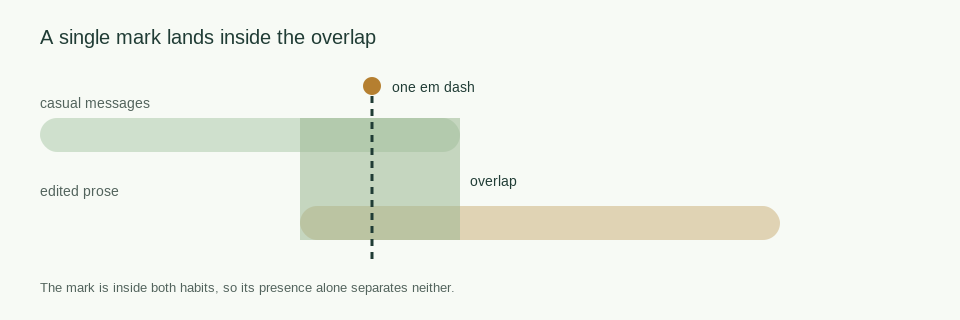
Three plain reasons, none of them mysterious. First, training text is weighted toward edited prose: books, journalism, documentation and reports, where the dash is normal and often prescribed by a house style. Second, instruction-tuned models are rewarded for prose that reads as well-formed, and a dash is a cheap way to add structure without adding words. Third, the character costs a single token, so it is efficient to emit.
The combined effect is a register, not a fingerprint. A model's default voice sits closer to a magazine column than to a text message. Plenty of people write in that same register, and many of them are paid to.
Editing pulls in the same direction
Copy-editing tends to break long sentences apart and to replace loose commas with dashes. Text that has passed through a professional editor, a translation step, or a house style can end up looking more machine-like than the same writer's first draft. A dashed sentence may point to a language boundary or a style guide rather than to a model.
The mistake underneath the claim
People usually reason in one direction and conclude in the other. From “model output often contains dashes” they infer “text with dashes is often model output”. Those are different statements, and the second one needs a base rate that the first does not supply. If a large share of ordinary prose contains the mark, seeing the mark barely moves your estimate.
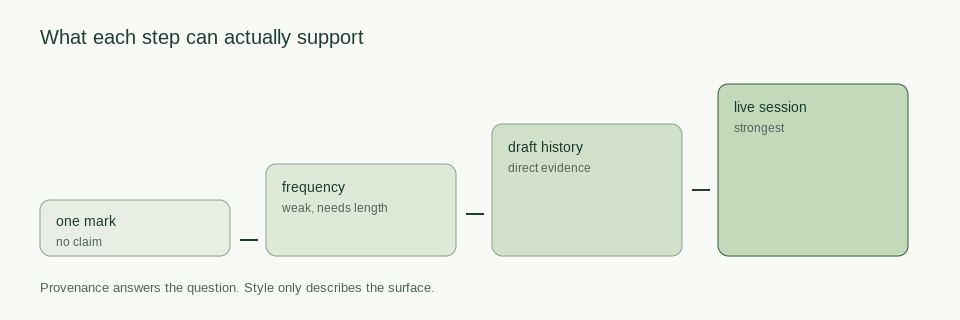
Frequency is the level at which a clue can carry any weight at all. If a habit really is far more common in one kind of text, a long sample can shift a probability. A short sample usually cannot, and one character never does.
What would actually settle it
Provenance, not style. A draft history, a revision log, editor notes with timestamps, or a recorded writing session all speak to origin directly. An interview about how a passage was made does the same. Surface marks tell you about the surface.
How to play and read your score
A round shows eight claims, one at a time. Choose true or false for each; the choice locks and the explanation appears. A correct call earns one point.
0–4: in this round you often accepted a style clue as proof. Try asking what else could produce the same mark. 5–6: you separated habit from evidence but let a couple of plausible-sounding claims through. 7–8: you held the line between a frequency clue and an identity claim. This score describes your choices in this round, not your ability to detect AI.
Question design and source notes
Designed October 27, 2026. The eight claims and their explanations were written with AI for this exercise. They are editorial statements about reasoning, not results from a study, and no claim here rests on a measured error rate.
The exercise is our editorial design, not a validated assessment. This page is not an AI detector. It does not classify submitted text and it does not connect you to another player.
For background on how surface style and detector verdicts diverge across writing groups, see Liang et al. (2023); it is context, not validation of this page. On dash conventions in edited prose, the Chicago Manual of Style is the reference to read for what a house style actually prescribes.
Where to go next
- Does AI use a lot of hyphens? → · Check your own writing against five surface features and see which ones carry no weight.
- Play the Typo Trap for the opposite error: treating a mistake as proof of a person.
- Read why human writing can sound artificial before you trust a style verdict.
- Turn a paragraph into a bulleted list and watch the same words read as machine output.
- Recast one report in short, mixed and long sentences and watch the word counts move while the facts stay put.
- Read what happened to the strongest tell of all once everyone learned it.
- See what a detector is actually scoring and why the number is not an identity claim.
Does AI use a lot of semicolons? →