HUMAN OR AI · SEMICOLONS
Does AI use a lot of semicolons?
Often in explanatory prose — because a semicolon does a precise job. It joins two complete sentences that belong together, closer than a full stop and tighter than a comma. A model writing explanation reaches for that move because people who write explanation reach for it. What gets counted as a "semicolon habit" is usually a feature of the register.
This page is not about catching a model. It is about taking one pair of clauses and swapping the join, so you can see exactly what a semicolon adds and what it does not.
Swap the connector
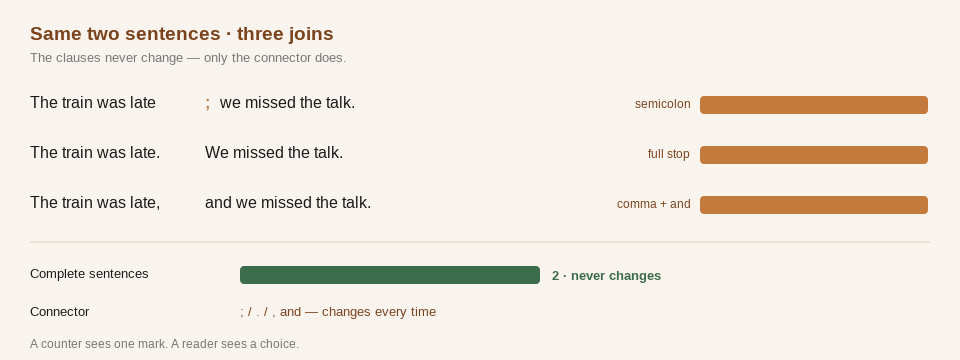
SemicolonSame two complete sentences, three ways to join them. The clauses never change. Only the join does.
What a semicolon actually does
A semicolon sits between a comma and a full stop. It joins two independent clauses — each could stand alone as a sentence — and tells the reader they belong to one thought. The train was late; we missed the talk. Two sentences, one beat. Swap the semicolon for a full stop and nothing about the events changes; only the closeness changes.
Why models reach for them
Explanatory writing is full of paired clauses: a claim and its reason, an observation and its exception. A semicolon packages the pair into one clean unit, which is exactly what an explanation needs. A model trained on explanations learns that packaging. Give the same model a text message or a shopping list and the semicolons mostly vanish — not because the model changed, but because the register did.
The same inversion shows up with the em dash, the Oxford comma and short sentences: the punctuation follows the document type. A rule that tracks a register will happily accuse a human writing in that register.
When a semicolon carries real information
- Separating items that contain commas. We visited Paris, France; Lyon, France; and Geneva, Switzerland — here the semicolon prevents the list from collapsing. Remove it and the meaning blurs.
- Joining closely related clauses. It rained all morning; the match was cancelled. A full stop would work, but the semicolon signals the cause. This is a style choice, not an added fact.
- Joining clauses with a conjunctive adverb. The data was thin; however, the trend held. The semicolon is required here where a comma would splice. This one is grammar, not style.
A counter sees one character. A reader sees three different jobs. That is why the number of semicolons is a weak signal and the reason for each one is the real question.
The tell that is not a tell
Semicolon density is easy to measure, which makes it attractive to scoring tools. But academic writing is dense in them, legal writing is dense in them, and many newspaper style guides discourage them entirely — all written by people following a house style. The same mark is a habit in one outlet and an error in another.
Use the same test as the guide to writing tells: move the sentence to another kind of document. If the semicolons change with the setting, you have measured the setting.
What swapping them will not do
Deleting every semicolon does not make a passage human. It breaks the pairs into shorter sentences with the same underlying details, and a surface-level score will find a different surface to count. If the clauses had no checkable content to begin with, changing the join leaves that problem untouched — the same trap as perfect grammar.
This page is not an AI detector. It accepts no text, calls no model and scores nobody. The switch and the readout run only in your browser. Existing site analytics are described in our privacy policy.
Related reading and practice
Does AI use a lot of parentheses? → · Does AI use a lot of hyphens? → · Does AI use a lot of colons? → · AI writing questions, answered → · Does AI use a lot of quotation marks? → · Is the em dash a sign of AI writing? → · Does AI use the Oxford comma? → · Do bullet points mean AI? → · Does AI write in short sentences? → · Does AI use a lot of adverbs? → · Do AI detectors actually work? → · Play the Human or AI game →