HUMAN OR AI · SENTENCE LENGTH
Does AI write in short sentences?
Yes — and so does anyone who wants you to slow down. A short sentence is a lever a writer pulls to make a point land. Manuals, news leads, children's books and protest signs are full of them because they need to be read fast and remembered. A model that writes in those registers will produce them too. The length belongs to the job the sentence is doing.
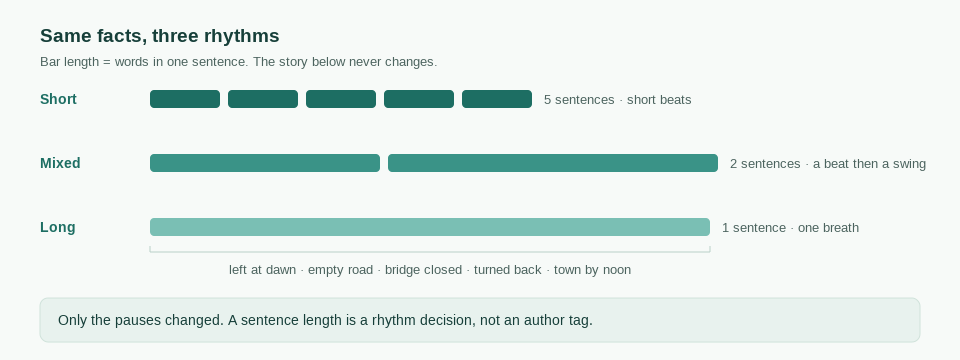
This page is not about catching a model. It is about cutting one set of facts into short, mixed and long sentences, then watching the word counts change while the facts sit perfectly still.
One report, three rhythms
MixedSame five facts in every version. Only the pauses move. Pick a rhythm and watch the bars.
- One departure: we left at dawn
- One condition: the road was empty
- One obstacle: the bridge was closed
- One decision: we turned back
- One arrival: we reached town by noon
What the bars actually measured
Only word counts. The exercise re-punctuates the same report in three ways: five short sentences, two middle-sized ones, or one long one. Nothing was added and nothing was cut. The chart redraws because the pauses moved, not because the story grew.
Why short sentences get called artificial
Short sentences are easy to count, which makes them a favourite feature in simplistic writing scores. A passage with many full stops looks mechanical to a rule that equates variety with length. But a rule like that has never met an instruction manual, a news ticker or a children's book — all written by people, all built on short lines on purpose.
The association also comes from a narrow sample. When the text being judged is a flat explainer, everything about it looks flat, including the sentences. Change the register and the sentences change with it. Word habits and passive voice behave the same way: follow the document, not the author.
Who writes short on purpose
- Instructions. One action per sentence keeps a procedure unambiguous. Step three should not contain a subordinate clause.
- News leads. The first line carries the fact before the reader decides whether to continue. Length there is a design decision.
- Fiction with a beat. A writer drops to a short sentence after a long one to make it hit. The effect only works because the short line is short.
- Signs and slogans. A sign has one glance. Brevity is forced by the medium, not chosen by a model.
Every one of those has a reason you can write down for the sentence being short. A reason you can explain is a fact about the genre, not a fingerprint.
Rhythm is relative, not absolute
No sentence is short on its own. It is short next to the sentence before it. A ten-word line feels clipped after a thirty-word one and feels rambling after a four-word one. That is why counting full stops without reading the neighbours tells you almost nothing about a writer.
Try the same test used in the guide to writing tells: move the passage into a different kind of document and see whether the sentence lengths survive. If they change with the setting, you have measured the setting.
What this exercise will not do
Turning a passage into short sentences does not make it human. It makes it a different passage with the same facts, and a score based on surface counts will simply find another surface to count. If the report has no detail you could check, re-punctuating it leaves that problem exactly where it was. Short texts are hard to judge for the same reason.
This page is not an AI detector. It accepts no text, calls no model and scores nobody. The recast and the bar chart run only in your browser. Existing site analytics are described in our privacy policy.
Related reading and practice
Does AI repeat itself? → · Does AI use a lot of semicolons? → · Does AI use a lot of adverbs? → · Do bullet points mean AI? → · Is the em dash a sign of AI writing? → · Does AI use contractions? → · Is the rule of three a sign of AI writing? → · Does AI use the Oxford comma? → · Does a long answer prove someone is AI? → · Play the Human or AI game →