HUMAN OR AI · PARENTHESES
Does AI use a lot of parentheses?
Sometimes — but a bracket count tells you almost nothing on its own. Parentheses hold an aside. That aside can be a date, a definition, a clarification or pure tone. Two passages with the same number of brackets can carry completely different amounts of information, so counting them measures a habit, not an author.
This page is not about catching a model. It takes one fixed passage with three parenthetical asides and lets you unpack them, so you can see exactly which ones were carrying a fact and which were carrying nothing.
Pack or drop the aside
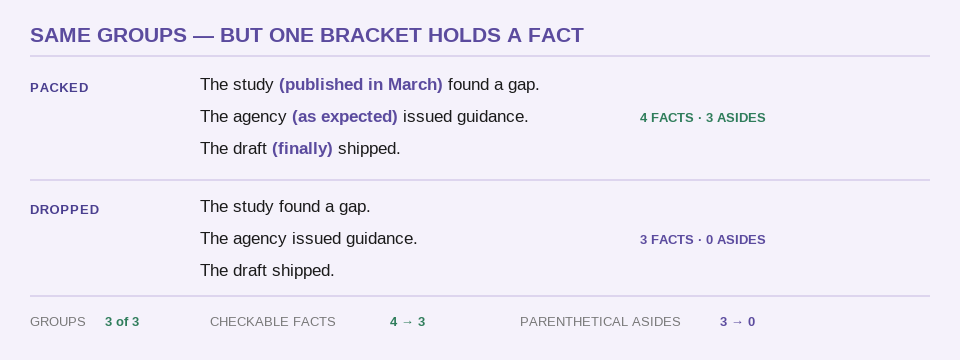
PackedSame three groups. Watch the fact count when the brackets come off.
Three brackets, three different jobs
One bracket here holds a date: the study (published in March) found a gap. Drop it and you lose a checkable fact. The other two hold tone: the agency (as expected) issued guidance and the draft (finally) shipped. Drop those and the sentence keeps every claim it had. Same punctuation, three different amounts of information.
Why the count is a weak signal
A writer who explains as they go reaches for brackets; so does a model that has learned to hedge. A translator may add a bracketed gloss. A style guide may ban them entirely, or require them for citations. All of that changes the bracket count without touching who wrote the sentence or what it claims.
This is the same shape as the colon page and the semicolon page: the mark is a container, and what matters is what got put inside it. The difference here is that a bracket can hold a real fact, so removing one can change the information — which is exactly why the count alone proves nothing.
When a bracket carries real information
- A date or a figure. The study (published in March) found a gap gives you something to check. Remove it and the claim gets vaguer, not more human.
- A definition. The agency (the WHO) issued guidance tells you which agency. Without it, the sentence is still true but less specific.
- A tone marker. The draft (finally) shipped adds impatience, not a claim. This is the only kind you can delete for free.
The test is the same one used on the repetition page: take the aside out and ask whether anything you could verify disappeared. If it did, the bracket was doing work. If not, it was decoration.
The tell that is not a tell
Academic writing brackets its citations. Technical writing brackets its units. Casual writing brackets its jokes. None of those are fingerprints of a model, and all of them survive translation and editing differently. A passage with many brackets may simply be careful; a passage with none may simply be following a house style.
Use the same test as the guide to writing tells: move the sentence into a different document type. If the brackets change with the container, you have measured the container — the same point made in why human writing can sound like AI.
What removing them will not do
Deleting every bracket does not make a passage human. It strips out whatever the brackets were holding — sometimes a date, sometimes a joke — while the underlying claims sit where they were. A detector that counts brackets will simply find a different surface to count. If the sentences had no checkable content to begin with, unpacking the asides leaves that problem untouched — the same trap as perfect grammar.
This page is not an AI detector. It accepts no text, calls no model and scores nobody. The switch and the readout run only in your browser. Existing site analytics are described in our privacy policy.
Related reading and practice
AI writing questions, answered → · Does AI use a lot of colons? → · Does AI use a lot of semicolons? → · Does AI repeat itself? → · Does AI use a lot of hyphens? → · Do AI detectors actually work? → · Play the Human or AI game →