HUMAN OR AI · HYPHENS AND DASHES
Does AI use a lot of hyphens?
Sometimes — but the count usually measures the file, not the writer. A hyphen, an en dash and an em dash are three different marks with three different jobs. Copy them into a plain-text field, an old system or a scanned PDF and they often collapse into one character. What gets counted as a "hyphen habit" may be a transport decision made downstream.
This page is not about catching a model. It is about taking three real uses of the three marks and flattening them, so you can see exactly what survives and what disappears.
Flatten the marks
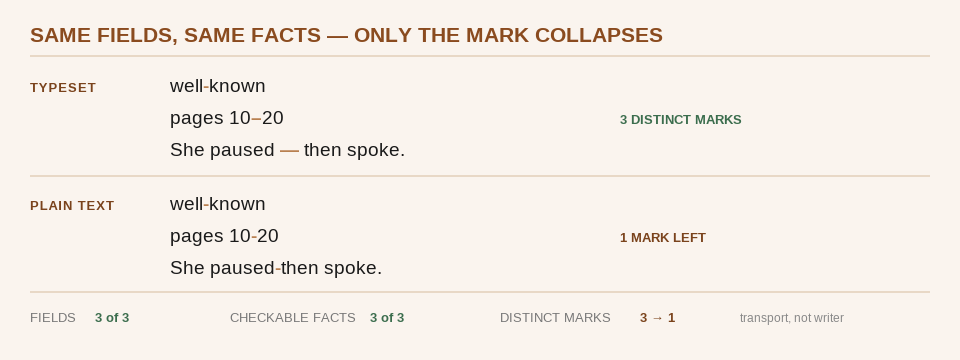
TypesetSame three fields, same three facts. Only the dashes change shape.
Three marks, three jobs
The short hyphen - joins words into a compound: well-known, state-of-the-art. The medium en dash – spans a range: pages 10–20, Monday–Friday. The long em dash — breaks a sentence: She paused — then spoke. A reader uses the length to tell the jobs apart; a counter that only sees "a dash" throws that information away.
Why the flattening happens
Plain-text systems have one hyphen key. When a document with en and em dashes moves through a form field, a legacy database, a plain-text export or a character-limited post, the distinctive marks are often mapped down to the closest ASCII character. Nothing about the content changed; the transport layer simplified it. The same thing happens when OCR reads a scanned PDF and chooses the common character for all three.
This is the mirror image of the em dash question. That page asks whether one long mark proves a model wrote a sentence. This one asks what happens when all three marks are forced to look alike — and shows that the answer depends on the file format as much as the hand that typed it.
When the mark carries real information
- A compound needs its hyphen. A well-known author and a well known author are read differently. Here the mark is doing grammar, not style.
- A range needs a dash with space around it. 10–20 reads as a span; 10-20 is a hyphen where a dash belongs. Flattening blurs the distinction, but the numbers are the same numbers.
- A sentence break needs the long dash. She paused — then spoke and She paused, then spoke are the same events with a different beat. The dash is pacing, not a new fact.
A counter sees one character class. A reader sees three marks doing three different jobs. That is why a raw hyphen count is a weak signal and why the question is always what the mark is doing in that sentence.
The tell that is not a tell
House styles disagree about all three marks. Some outlets ban the em dash entirely; some style guides prefer a spaced en dash in its place; technical writing leans on hyphens in compound terms. All of those are choices made by people following a rulebook. Feed the same sentence through two different editors and the dash count changes without a single fact moving.
Use the same test as the guide to writing tells: move the sentence to another document type or another file format. If the dashes change with the container, you have measured the container.
What changing them will not do
Converting every dash into a hyphen does not make a passage human. It removes a layer of punctuation information while the underlying claims sit exactly where they were. A surface-level score will simply find a different surface to count. If the sentences had no checkable content to begin with, flattening the dashes leaves that problem untouched — the same trap as perfect grammar.
This page is not an AI detector. It accepts no text, calls no model and scores nobody. The switch and the readout run only in your browser. Existing site analytics are described in our privacy policy.
Related reading and practice
Does AI use emojis? → · AI writing questions, answered → · Is the em dash a sign of AI writing? → · Does AI use a lot of colons? → · Does AI use a lot of semicolons? → · Does AI use a lot of quotation marks? → · Does AI write in short sentences? → · Do AI detectors actually work? → · Play the Human or AI game →