HUMAN OR AI · COLONS
Does AI use a lot of colons?
Often in explanatory prose — because a colon makes a promise. It tells the reader that what comes next will cash out what came before: a list, a reason, an example, a quotation. A model writing explanation reaches for that move because people who write explanation reach for it. What gets counted as a "colon habit" is usually a feature of the register.
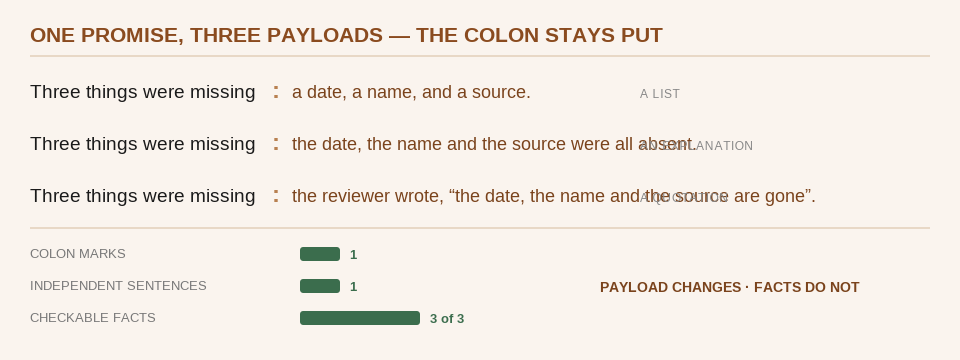
This page is not about catching a model. It is about taking one promise and swapping what the colon delivers, so you can see exactly what the mark adds and what it does not.
Swap what the colon introduces
A listSame promise before the colon, same facts after it. Only the kind of payload changes.
What a colon actually does
A colon is a promise mark. The words before it set up an expectation — a reason is coming, a list is coming, someone's exact words are coming — and the words after it pay that expectation off. Three things were missing: a date, a name, and a source. Swap the payload for a reason or a quotation and the promise is kept differently, but nothing about the three missing things changes.
Why models reach for them
Explanatory writing is full of setup-and-payoff pairs: a claim and its reason, a count and its list, a speaker and their words. A colon packages the pair into one clean unit, which is exactly what an explanation needs. A model trained on explanations learns that packaging. Give the same model a text message or a shopping list and the colons mostly vanish — not because the model changed, but because the register did.
The same inversion shows up with the em dash, semicolons and short sentences: the punctuation follows the document type. A rule that tracks a register will happily accuse a human writing in that register.
When a colon carries real information
- Introducing a list after a complete clause. We need three things: time, budget, and sign-off. The colon tells the reader the count is exact. Remove it and the list still reads, but the promise is gone.
- Introducing an explanation or example. One thing was clear: the date was wrong. Here the colon says "here is the specifics." A full stop would work, but it would break the link between claim and evidence.
- Introducing a quotation after a setup. She said one thing: check the source. Formal prose uses a colon here where dialogue often uses a comma. That is a house-style choice, not a changed fact.
A counter sees one character. A reader sees three different jobs. That is why the number of colons is a weak signal and the reason for each one is the real question.
The tell that is not a tell
Colon density is easy to measure, which makes it attractive to scoring tools. But academic writing is dense in them, legal writing is dense in them, and technical documentation is dense in them — all written by people following a house style. The same mark is a habit in one outlet and an error in another.
Use the same test as the guide to writing tells: move the sentence to another kind of document. If the colons change with the setting, you have measured the setting.
What swapping them will not do
Deleting every colon does not make a passage human. It breaks the setup and payoff into separate sentences with the same underlying details, and a surface-level score will find a different surface to count. If the payload had no checkable content to begin with, changing the mark leaves that problem untouched — the same trap as perfect grammar.
This page is not an AI detector. It accepts no text, calls no model and scores nobody. The switch and the readout run only in your browser. Existing site analytics are described in our privacy policy.
Related reading and practice
Does AI use a lot of parentheses? → · Does AI use a lot of hyphens? → · AI writing questions, answered → · Does AI use a lot of semicolons? → · Does AI use a lot of quotation marks? → · Is the em dash a sign of AI writing? → · Does AI use the Oxford comma? → · Do bullet points mean AI? → · Does AI write in short sentences? → · Do AI detectors actually work? → · Play the Human or AI game →