HUMAN OR AI · REPETITION
Does AI repeat itself?
Often — but a repeated sentence is usually a restatement, not a second fact. Models are fond of saying the same thing twice in different words: a claim, then a polished echo of the claim. The echo looks like padding. Trim it away and the passage gets shorter while the set of checkable claims sits exactly where it was.
This page is not about catching a model. It takes one fixed passage with three visible echoes and lets you strip them out, so you can see precisely what disappears and what does not.
Strip the restatements
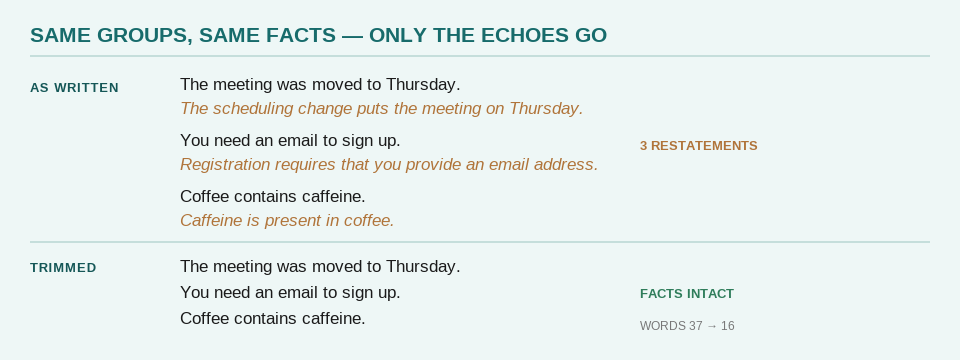
As writtenSame three groups, same three facts. Only the repeated phrasing is removed.
Three echoes, three facts
Each group below states a plain fact and then says it again in a different shape. The meeting was moved to Thursday comes back as the scheduling change puts the meeting on Thursday. The second sentence adds no new checkable claim; it restates the first with different words. Count the facts and the group holds at one.
Why restatement is not a second claim
A fact is something you could check: was the meeting moved, is an email needed to sign up, does coffee contain caffeine. A restatement rewords the same fact without adding a new one. It is easy to mistake the extra sentence for extra content because it takes up more space on the page. It does not. The list of things you could verify is unchanged.
This is the mirror image of the page on overused words. That one looks at single words that appear too often. This one looks at whole sentences that repeat a claim — a bigger, more visible habit that still leaves the underlying facts intact once removed.
When the repeat carries real information
- A restatement can add a detail. The meeting moved to Thursday — to the same room as last week repeats the move but adds a location. Keep the second half; it is a new checkable fact.
- Parallel wording is sometimes the point. A list or a slogan repeats a structure on purpose to make it memorable. The repetition is the design, not filler.
- An echo can fix ambiguity. Restating a claim in plainer words after a technical sentence can help a reader who missed the first version. That is a clarity choice, not padding.
In each case the test is the same one used on the rule of three: ask whether the second version lets you verify anything the first did not. If it does not, you have found a restatement.
The tell that is not a tell
People repeat themselves too, especially in drafts, speeches and instructions. Editors are trained to cut it. A translation, a summary or a forced length target can also make a passage repeat a claim without any model involved. Feed the same fact through two editors and the number of echoes changes while the fact stays put.
Use the same test as the guide to writing tells: remove the repeated sentences. If the set of checkable claims survives untouched, you removed phrasing, not content — the same distinction that runs through why human writing can sound like AI.
What removing it will not do
Cutting every echo does not make a passage human. It shortens the surface while the underlying claims sit exactly where they were. A detector that counts repeated phrasing will simply find a different surface to count. If the sentences had no checkable content to begin with, trimming the echoes leaves that problem untouched — the same trap as perfect grammar.
This page is not an AI detector. It accepts no text, calls no model and scores nobody. The switch and the readout run only in your browser. Existing site analytics are described in our privacy policy.
Related reading and practice
Does AI use a lot of parentheses? → · Does AI use emojis? → · AI writing questions, answered → · Does AI overuse certain words? → · Is the rule of three a sign of AI writing? → · Does AI write in short sentences? → · Does AI use adverbs? → · Do AI detectors actually work? → · Play the Human or AI game →