HUMAN OR AI · PASSIVE VOICE
Does AI use passive voice?
Yes, more than casual writing does — and that tells you almost nothing about who wrote it. Passive voice is a construction the sentence needs when the action matters more than the actor. Lab reports, lab manuals, news briefs and legal notices are full of it because those documents have rules about what to put first. A language model has learned those rules from the same documents. The form belongs to the genre.
This page is not about spotting a model. It is about watching one sentence change shape while the facts stay perfectly still, and seeing how little the shape tells you.
Flip one sentence
PassiveSame experiment, same result. Only the focus changes. Tap either construction.
- One experiment: a 48-hour trial
- One actor: the research team
- One result: the samples were measured twice
Where would you expect to meet this sentence?
What the flip actually did
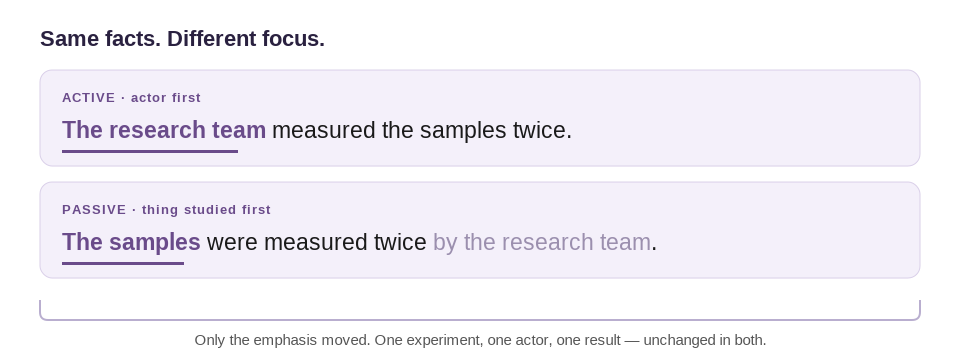
Grammatical voice is a switch over which noun phrase goes first. Active puts the actor in the subject position: the research team measured the samples. Passive promotes the object: the samples were measured by the research team. Both name the actor. Both name the action. Nothing moved except the emphasis.
Writers reach for the passive when the thing acted on is the interesting part. In a lab report the samples are the story and the team is interchangeable, so the samples go first and the actor can even disappear: the samples were measured twice. That is not evasive writing in a lab report. It is the correct way to write one.
Why models lean on it
A language model is trained to continue text that resembles its training text. A large share of the explanatory, technical and institutional prose in that training uses passive constructions, because those registers prefer the thing studied over the person studying it. When a model writes in an explanatory register, passive voice is simply the continuation that fits.
That produces a real tendency. It also produces a bad inference. The tendency is in the register, not in the authorship. Give the same model a prompt for a text message and the passives largely vanish, because the register changed. Give a human a lab report to write and the passives arrive, because the register changed for them too.
The genres that require it
- Methods sections. The convention is to describe what was done, not who did it. The actor is often unnecessary and sometimes deliberately withheld during review.
- News briefs. "A decision was reached" keeps the institution's process in focus, and in some contexts protects a source. Editors teach this explicitly.
- Notices and rules. "Fees are charged monthly" describes a standing arrangement. Naming a clerk would make a general rule sound like a personal act.
- Bad-news messages. Passive softens agency: "the order was cancelled" lands differently from "we cancelled your order." Customer-service templates are full of it.
Every one of those genres has human authors who can show you the style guide that told them to write that way. A rule someone can look up is not a mark someone can be identified by.
How this differs from the other tells
Vocabulary habits, long answers, contractions and the serial comma all describe surface choices. Passive voice is one step closer to structure: it is about where the sentence puts its emphasis. That makes it feel more revealing, but the extra depth does not help with authorship. Emphasis is even more tightly controlled by genre than word choice is.
The practical test is the same as the one in the guide to writing tells: ask whether the feature follows the document or the person. Move the sentence into a different kind of document and see whether it stays. If the construction changes with the genre, you have learned about the genre.
What flipping the sentence will not do
Rewriting every passive into an active does not make a text human. It makes it a different text with the same facts, and detectors that score surface features will simply find another feature. If the underlying passage has no verifiable detail, changing the voice leaves that problem untouched. Perfect grammar is no proof either, for the same reason: a correct sentence has no author tag on it.
This page is not an AI detector. It does not accept text, call a model, or score anyone. The flip and the poll run only in your browser. Existing site analytics are described in our privacy policy.
Related reading and practice
Does AI use a lot of adverbs? → · Does AI overuse certain words? → · Does using big words mean AI? → · Is the rule of three a sign of AI writing? → · Does AI use contractions? → · Does AI use the Oxford comma? → · Do AI detectors actually work? → · Play the Human or AI game →