HUMAN OR AI · ADVERBS
Does AI use a lot of adverbs?
Often, in explanatory prose — but the adverbs are doing a specific job. Words like clearly, generally and essentially tell a reader how much confidence to place in the statement that follows. A model that writes explanations has learned to signal that stance, because human explanations do it constantly. What gets counted as an "AI habit" is usually a feature of the explanatory register.
This page is not about catching a model. It is about taking one sentence apart one adverb at a time and watching exactly what disappears.
Strip the adverbs
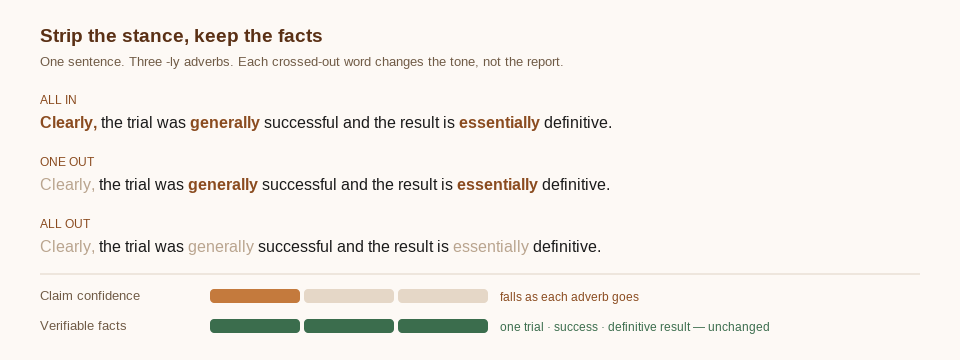
4 leftEach switch removes one adverb. The facts below never change. Watch how the claim sounds without the stance words.
What an adverb adds to a claim
Most -ly adverbs in explanatory prose are stance markers. Clearly says the writer expects agreement. Generally says the statement is a tendency with exceptions. Essentially says the detail that follows is the core one. None of those words adds a fact. They tell the reader how to hold the fact.
Why models reach for them
Explanations are full of hedges and signposts because a human reader needs to know what is certain and what is approximate. A model trained on explanations reproduces that scaffolding. Give the same model a shopping list, a text message or a set of instructions and the adverbs mostly vanish — not because the model changed, but because the register did.
The same inversion shows up with overused words and passive voice: the feature follows the document type. A rule that tracks a register will happily accuse a human writing in that register.
Which adverbs carry real information
- Manner adverbs. She walked quietly adds a fact about how the walking happened. Remove it and the picture loses information.
- Frequency adverbs. The train usually arrives at eight is a different claim from the train arrives at eight. This one changes the facts.
- Stance adverbs. Clearly, obviously, arguably mostly signal confidence. Removing them changes the tone, often not the verifiable content.
- Domain adverbs. Technically and legally narrow which rules apply. Those are doing precise work and should stay.
A count treats all four as identical tokens. A reader does not. That is why the number of adverbs is a weak signal and the kind of adverb is a real question.
The tell that is not a tell
Density of -ly words is easy to measure, which makes it attractive to scoring tools. But an instruction manual is dense in manner adverbs, an academic abstract is dense in stance adverbs, and a press release is dense in both — all written by people with style guides in front of them.
Use the same test as the guide to writing tells: move the sentence to another kind of document. If the adverbs change with the setting, you have measured the setting.
What stripping them will not do
Deleting every adverb does not make a passage human. It makes it a blunter passage with the same underlying details, and a surface-level score will find a different surface to count. If the sentence had no checkable detail to begin with, removing stance words leaves that problem untouched — the same trap as perfect grammar.
This page is not an AI detector. It accepts no text, calls no model and scores nobody. The switch and the readout run only in your browser. Existing site analytics are described in our privacy policy.
Related reading and practice
Does AI overuse certain words? → · Does AI use passive voice? → · Does AI write in short sentences? → · Does using big words mean AI? → · Does AI use contractions? → · Do AI detectors actually work? → · Play the Human or AI game →