HUMAN OR AI · EMOJI
Does AI use emojis?
Sometimes — but an emoji count usually measures the channel, not the writer. The same message can show three colourful glyphs on a phone, the words "party popper", "warning sign" and "slightly smiling face" to a screen reader, and nothing at all in a plain-text export. Nothing about the message changed; the rendering did.
This page is not about catching a model. It takes one fixed message with three emoji and swaps them for the words a reader hears, so you can see exactly what vanishes and what stays.
Decode the glyphs
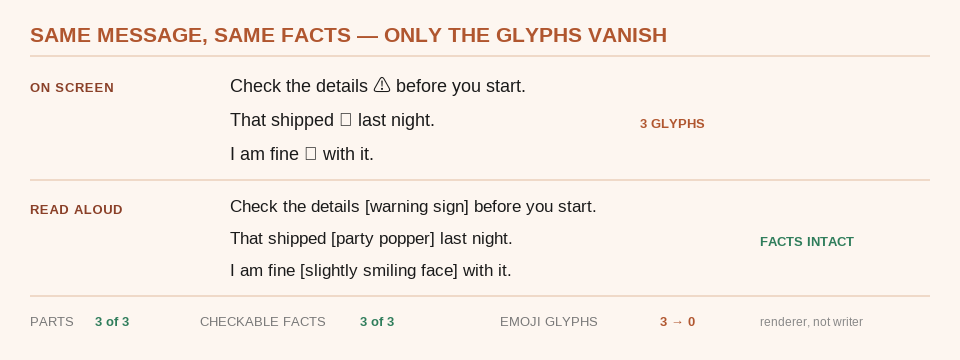
On screenSame three parts, same three facts. Only the emoji become their spoken names.
Three glyphs, three spoken names
A screen reader does not see a yellow face; it hears the name of the character. A warning sign becomes warning sign, a party popper becomes party popper, a slight smile becomes slightly smiling face. The three glyphs on screen and the three spoken names carry the same message — one is drawn, the other is read aloud.
Why the glyph count moves
Emoji are characters with no single fixed appearance. Each platform draws them differently, a screen reader replaces them with a name, and a plain-text field or an old system often drops them entirely. A count of "how many emojis" therefore measures which renderer handled the message. Copy the same sentence into a document that strips formatting and the glyphs disappear while every claim survives.
This is the same shape as the hyphen and dash page, where a mark changes with the file format. Here the mark changes with the viewing device. Both point at the same mistake: treating a presentation choice as a signature of the person who wrote it.
When an emoji carries real information
- It can replace a word. Ship it 🎉 marks a celebration the plain sentence does not. Read aloud as "party popper", that tone survives — the glyph is a carrier, not the whole meaning.
- It can be a list marker. 👉 Step one uses the emoji as a pointer. Remove it and the step is still step one. The marker is layout, not content.
- It can read as sarcasm. Fine 🙂 leans on the reader knowing the face. That meaning depends on shared context, not on the model that produced the character.
In each case ask what the emoji adds that could be checked. If the answer is "a tone" or "a pointer", you are looking at presentation — the same test used on bullet points and the rule of three.
The tell that is not a tell
People use emoji heavily in messages, marketing and social posts; brands have style guides for them. A translated post, a chat export or a platform that auto-suggests emoji can add them without a model anywhere in the chain. Different renderers also show the same character in visibly different ways, so a screenshot can make the same message look wildly different.
Use the same test as the guide to writing tells: strip the glyphs. If the set of checkable claims survives untouched, you removed decoration, not substance — the distinction that runs through why human writing can sound like AI.
What removing them will not do
Deleting every emoji does not make a passage human. It shortens the surface while the underlying claims sit exactly where they were. A detector that counts emoji will simply find a different surface to count. If the sentences had no checkable content to begin with, stripping the glyphs leaves that problem untouched — the same trap as perfect grammar.
This page is not an AI detector. It accepts no text, calls no model and scores nobody. The switch and the readout run only in your browser. Existing site analytics are described in our privacy policy.
Related reading and practice
AI writing questions, answered → · Does AI use a lot of hyphens? → · Do bullet points mean AI? → · Does AI repeat itself? → · Does AI overuse certain words? → · Do AI detectors actually work? → · Play the Human or AI game →