HUMAN OR AI · QUOTATION MARKS
Does AI use a lot of quotation marks?
Often in explanation — but the marks are doing a job. Quotation marks flag that a phrase is someone's exact words, a label, or a term being named rather than used. A model writing explanation reaches for them because human explanation does. The much-discussed straight-versus-curved difference is a separate matter entirely: which mark appears is decided by your keyboard, your editor and your font.
This page is not about catching a model. It is about taking one reported line and changing only the marks around it, so you can see what a quotation mark adds and what it cannot.
Switch the marks
Straight quotesSame reported line, three ways to mark it. The claim and its source never change. Only the marks do.
What the marks actually do
A pair of quotation marks is a boundary. Around exact words it says these are the speaker's words, not mine. Around a label it says this is a name, not a claim I endorse. Around a term it says I am mentioning this word, not using it. None of those jobs depends on whether the marks curve. A straight apostrophe and a curly one carry the same boundary.
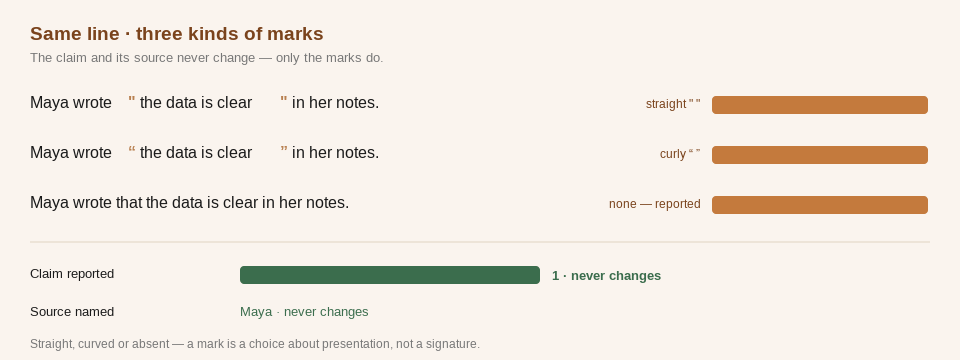
Straight or curly is a typography question
Plain text, code editors and older typewriters produce straight marks. Word processors and most publishing tools quietly turn them into curved opening and closing marks. The same sentence typed in two apps leaves you with two different characters — written by the same person, moments apart. A detector that treats the curved mark as a signature is reading the software, not the writer.
Scanned pages make the point sharper: optical character recognition often reads a curved mark back as a straight one. The mark you see in a copied passage can be an artefact of the conversion, not a choice by anyone who wrote the words. That is exactly the kind of surface a count will happily treat as evidence.
When the marks carry real information
- Exact quotation. She wrote "the data is clear" commits you to those words in that order. Drop the marks and you have a paraphrase. This is a real change.
- Scare quotes. The "experts" disagreed signals distance from the label. The reader learns the writer's stance, not a new fact.
- Mentioning a term. The word "clear" appears twice points at the word itself. Useful, but it is still a word on the page, not proof of who typed it.
A counter sees the same character in all three. A reader sees three different intentions. The number of quotation marks is a weak signal; the reason for each pair is the real question.
The tell that is not a tell
Quotation-mark density is easy to measure, which makes it attractive to scoring tools. But technical writing is dense in mentioned terms, journalism is dense in exact quotes, and academic style guides disagree about labels — all written by people following a convention. The same mark is routine in one outlet and conspicuous in another.
Use the same test as the guide to writing tells: move the sentence to another document type. If the marks change with the setting, you have measured the setting.
This is a different question from whether a quote proves who wrote a message. That page checks whether a quotation can be traced and attributed. This one only looks at the marks around one line and asks what they can signal.
What changing them will not do
Replacing curved marks with straight ones does not make a passage human. It changes the characters on the page while the claim and its source stay identical, and a surface-level score will find a different surface to count. If the line had no checkable content to begin with, swapping marks leaves that problem untouched — the same trap as perfect grammar.
This page is not an AI detector. It accepts no text, calls no model and scores nobody. The switch and the readout run only in your browser. Existing site analytics are described in our privacy policy.
Related reading and practice
Does AI use a lot of colons? → · AI writing questions, answered → · Is the em dash a sign of AI writing? → · Does AI use a lot of semicolons? → · Does AI use the Oxford comma? → · Does quoting a source prove someone is human? → · Does AI use a lot of adverbs? → · Do AI detectors actually work? → · Play the Human or AI game →